About Genicanthus melanospilos (Bleeker, 1857)
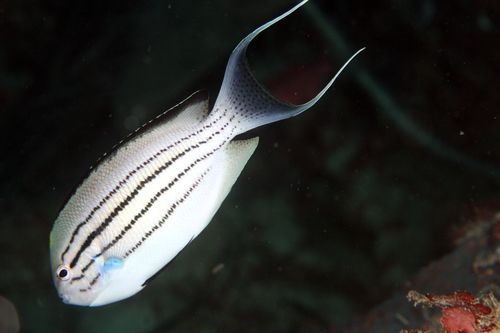
Genicanthus melanospilos (Bleeker, 1857), also called the spotbreast angelfish, displays sexual dichromatism, meaning males and females have different coloration. Males have a bluish white body background covered in many reddish-black vertical stripes. Their dorsal, caudal, and anal fins have yellow spots; the caudal fin is light yellow with blue edges and long filamentous lobes. Males also have a large black spot on the breast, near the base of the pelvic fins. For females, the dorsal half of the body is yellow, while the ventral half is bluish white. The female's tail is bluish, with a black stripe running along its upper and lower margins. Both sexes have a forked tail that narrows at the base, forming a "swallow tail" shape. The dorsal fin of this species has 15 spines and 15 to 17 soft rays, while the anal fin has 3 spines and 17 to 18 soft rays. The species reaches a maximum total length of 18 centimetres (7.1 in).
Genicanthus melanospilos is a widespread species that occurs in the eastern Indian Ocean and western Pacific Ocean. Its range extends across the Malay Archipelago into the southwestern Pacific, reaching as far east as Fiji, as far north as the Ryukyu Islands, and as far south as Australia. In Australian waters, it is found in the Indian Ocean around the Cocos (Keeling) Islands and Christmas Island, as well as at Ashmore Reef in the Timor Sea and the Great Barrier Reef off the coast of Cairns, Queensland.
This angelfish is found at depths ranging from 20 to 80 metres (66 to 262 ft). It lives in coral-rich areas on the outer slopes of reefs and along drop-offs. Adult fish typically form small harems, each consisting of one male and multiple females. They feed on zooplankton in the water column above reefs. Like all other angelfish, Genicanthus melanospilos is a protogynous hermaphrodite: all individuals are born female, and the dominant individuals later change sex to become male.