About Genicanthus caudovittatus (Günther, 1860)
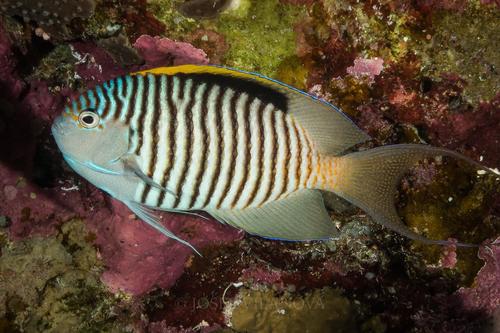
Genicanthus caudovittatus, also called the angelfish species first described by Günther in 1860, exhibits clear sexual dichromatism, meaning males and females have distinctly different coloration. Males have a whitish-blue base color, marked with vertical dark brown bars and a black band that runs along the middle of the dorsal fin base. Females are pale pinkish grey, with a black band over the eye and black bands along the upper and lower margins of the caudal fin. Both sexes have a noticeably forked caudal fin. The dorsal fin of this species holds 15 spines and 15 to 17 soft rays, while the anal fin has 3 spines and 17 to 19 soft rays. This species reaches a maximum total length of 20 centimetres, equal to 7.9 inches. Genicanthus caudovittatus is distributed in the western Indian Ocean. Its range runs along the eastern coast of Africa from the Red Sea in the north down to KwaZulu-Natal in South Africa, and extends east to Madagascar, the Maldives, Mauritius, and Réunion. It has also been recorded at Weh Island off the northwestern coast of Sumatra. This species occurs at depths between 15 and 70 metres, which is 49 to 230 feet. In the Red Sea, it can be found in shallower water than it occurs in the Andaman Sea. It inhabits steep outer reef slopes, where it lives in small groups consisting of one male and a small number of females. It feeds on plankton. Juveniles of this species live at greater depths than adults do.