About Genetta tigrina (Schreber, 1776)
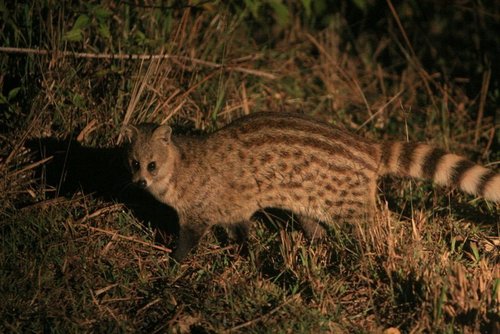
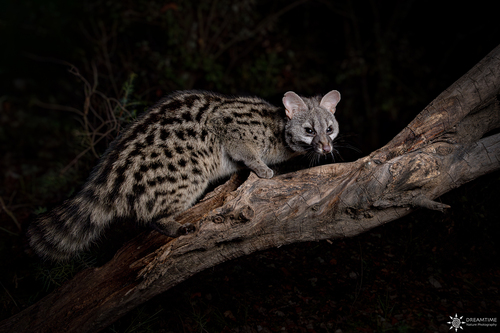
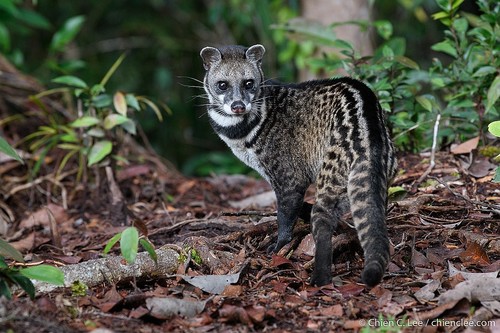
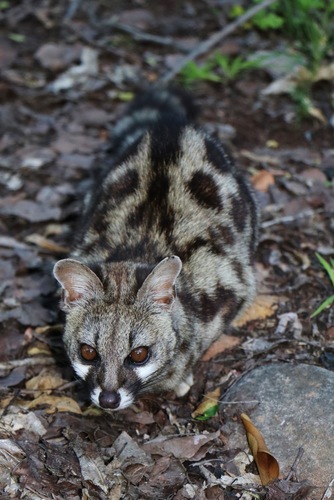
The Cape genet, scientifically named Genetta tigrina (Schreber, 1776), has the following physical characteristics. Its base fur is ash grey, covered with irregular brown spots, and it has a black stripe running along its spine. Its muzzle is white, with distinct white spots below each eye; its ears are grey, and its tail has alternating black and white bands ending in a black tip. Individuals living in regions with more than 375 mm (14.8 in) of annual precipitation are typically darker than those from drier areas. For body measurements: adult males have a head-and-body length between 460 and 580 mm (18 to 23 in), a tail length between 390 and 459 mm (15.4 to 18.1 in), and a weight between 1.6 and 2.1 kg (3.5 to 4.6 lb). Adult females have a head-and-body length between 427 and 560 mm (16.8 to 22.0 in), a tail length between 385 and 432 mm (15.2 to 17.0 in), and a weight between 1.36 and 1.870 kg (3.00 to 4.12 lb). Like all members of the subfamily Viverrinae, it has the dental formula 3.1.4.2 / 3.1.4.2. As with all genets, it possesses musk glands and anal sacs. It can be distinguished from other genets by its short dorsal crest, poorly spotted hind legs, and dark coloration on the back of the hind legs. In terms of distribution and habitat, the Cape genet is found in South Africa, ranging from the Western Cape to KwaZulu-Natal, south of 32°S, and extending to the Lesotho border. It is the most widely distributed and common small carnivore in KwaZulu-Natal. It rests in large trees, rock overhangs and caves, and inhabits moist environments near streams, rivers and standing water, in lowland and mountain fynbos with high vegetation cover. In ecology and behaviour, Cape genets are solitary and mostly active at night. During the day, they rest in trees high above the ground. They are both terrestrial and arboreal, but hunt and feed on the ground. They mark areas by depositing secretion from their anal sac. It is not confirmed whether they are territorial. They use shared latrine sites for defecation. They become active after dark to search for prey. They hunt by combining speed and stealth, dashing forward in an elusive pattern interrupted by short pauses. They hiss and growl when exposed to stressful situations. Olfactory communication is thought to play a very important role in their lives, social structure and life cycles. When walking on branches, they stay low and swing their legs out laterally to easily correct any missteps. Regarding feeding ecology, Cape genets feed mostly on rodents including African vlei rats, rock rats, and mice, as well as birds. Seeds, leaves and grass, plus beetles, grasshoppers, crickets, locusts and termites have also been found in their stomachs. They find most of their prey in low bushes and leaf litter, including African climbing mice, multimammate mice and African dormice. They are classified as opportunistic omnivores, because they also catch and eat insects, spiders, and scorpions, and will scavenge fish on beaches. It is hypothesized that eating grass may aid digestion, dislodge accumulated hair in the intestines, induce vomiting to expel ingested toxins, and relieve throat inflammation and stomach irritation. Birds do not make up a large portion of their diet. For reproduction, Cape genets appear to mate during the warm summer months. Pregnant females have been observed between September and November. Recorded newborn young weighed 70 g at birth. A captive breeding pair regularly produced litters of two young. The average gestation period is around 70 days. Females build nests in hollow trees, ground holes, or among boulders. Newborn young open their eyes 10 days after birth, and their canine teeth erupt at four weeks of age. They are weaned at around 2.5 months old and begin hunting independently at about seven months old. Captive Cape genets have been recorded living up to 15 years.