About Genetta genetta felina (Thunberg, 1811)
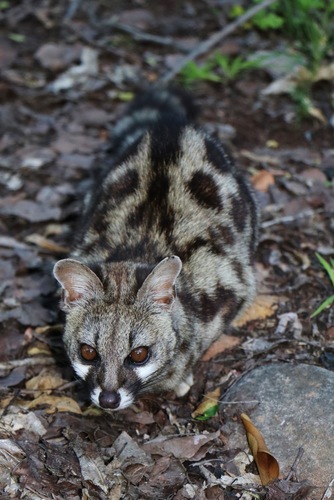
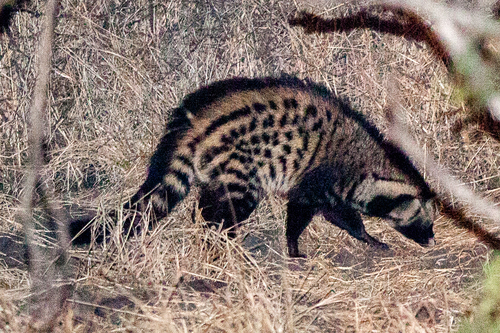
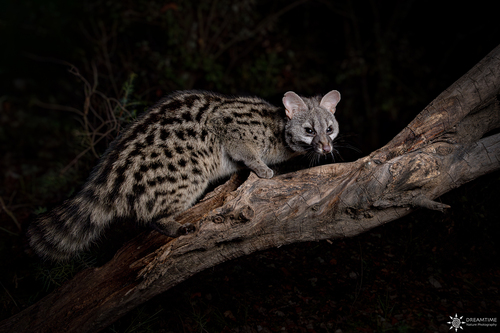
Characteristics: The common genet has a slender, cat-like body, small head with a pointed muzzle, large oval ears, large eyes, and well-developed whiskers that reach up to 7 cm (2.8 in) in length. Its legs are short, with cat-like feet and semi-retractile claws. Its fur is dense and soft, with a pale grey base coat marked by numerous black markings. The back and flanks bear around five rows of black spots, and a long black stripe runs along the midline of the back from the shoulders to the rump. There is an additional black stripe on the forehead, and dark patches beneath the eyes that contrast against the white fur of the chin and throat. The tail is striped, with between eight and thirteen rings along its length. Head-to-body length ranges from 43 to 55 cm (17 to 22 in), and the tail measures 33 to 52 cm (13 to 20 in) long. Males have an average weight of 2 kg (4.4 lb) and are approximately 10% larger than females. The species has an erectile crest of hair running from the shoulder to the base of the tail, a white tail tip, and black hind feet. One melanistic common genet was recorded in 2019 in southern Portugal.
Distribution and habitat: In North Africa, the common genet occurs along the western Mediterranean coast, and across a broad band that stretches from Senegal and Mauritania in the west, through the savannah zone south of the Sahara, to Somalia and Tanzania in the east. On the Arabian Peninsula, it has been recorded in coastal regions of Saudi Arabia, Yemen, and Oman. A separate discontinuous population lives in Southern Africa, ranging from southern Angola across Zambia and Zimbabwe to Mozambique. It occupies a wide variety of deciduous and evergreen habitats that provide abundant shelter, such as rocky terrain with caves and dense scrubland, and it also occurs close to settlements and agricultural land. It is common in Morocco and Algeria, but rare in Libya, Egypt, and Zambia. In South Africa, it is common in west-central KwaZulu-Natal, the Cape Province, and QwaQwa National Park in the Free State province. In the East Sudanian Savanna, it was recorded in the transboundary Dinder–Alatash protected area complex during surveys conducted between 2015 and 2018. In northern Ethiopia, it has been recorded in the mountainous Degua Tembien district. The common genet prefers areas with dense vegetation, including bushes, thickets, and evergreen oak forests. It uses trees with dense canopy foliage and dense thickets overgrown with climbing plants as resting sites. In northern areas, it prefers low elevations with high temperatures and low rainfall. In Manzanares Park in central Spain, it lives primarily in areas 1,000–1,200 m (3,300–3,900 ft) in elevation with many rocks and shrubs. It tolerates living near human settlements.
Introduced range: The common genet was brought to the Mediterranean region from the Maghreb as a semi-domestic animal roughly 1,000 to 1,500 years ago. It spread from the Iberian Peninsula to the Balearic Islands and southern France. Historically, its European range was thought to be bounded by the Loire and Rhône rivers, which were believed to block expansion north and east respectively. For this reason, specimens found outside southwestern France were considered captive escapees rather than evidence of wild breeding populations. However, large numbers of genets have been recorded east of the Rhône, too many to be explained by casual dispersal of escaped exotic pets. Combined with the presence of large breeding populations at the edge of the species' traditional range, this indicates that trans-Rhône specimens belong to established populations descended from individuals that crossed the river via urban-built bridges. Sporadic sightings have been recorded as far east as Italy, where individuals have been seen in mountainous areas of the Piedmont region and the Aosta Valley. Individuals sighted in Switzerland, Germany, and the Netherlands are still considered to have escaped or been released from captivity. In southwestern Europe, the common genet thrives in oak and pine forests, and also lives in olive groves, riparian zones, ash groves, rocky areas, and shrublands. It is rare in open areas, marshes, and cereal croplands. Although it is abundant along watercourses, access to water is not considered essential for the species. Specimens have been found in high-altitude areas of the Alps, but it remains unclear whether this reflects casual occurrence or that the habitat is truly suitable.
Ecology and behaviour: The common genet is a solitary species. Adults are nocturnal and crepuscular, with peak activity after sunset and just before sunrise; juveniles may be active during the day. They rest during the day in hollow trees or among thickets, and often reuse the same resting sites. A study in northeastern Spain found that males are more active at night than females, due to their larger size which gives males greater energy requirements to meet physiological needs. Females typically weigh less and are less active overall, and their home ranges are also smaller than those of males. Males had a mean annual home range of 113 ha (280 acres), compared to 72 ha (180 acres) for females. While males have larger home ranges in all seasons, the difference between male and female territories is most pronounced during the winter. Home ranges are slightly larger during spring, as genets are more active—they are not only active outside of nighttime, but also search for mates. Increased activity requires more energy, so genets move more to obtain enough food. The common genet has a varied diet that includes small mammals, lizards, birds, bird eggs, amphibians, centipedes, millipedes, scorpions, insects, and fruit such as figs and olives. The wood mouse is a particularly favoured prey. Genets locate prey primarily by scent, and kill with a bite to the neck, similar to cats. Small rodents are captured by the back, killed with a bite to the head, then eaten starting from the head. In Spain, common genets can be infected by parasitic worms, as well as ticks, fleas, and lice. They also host the phthirapteran species Eutrichophilus genettae and Lorisicola (Paradoxuroecus) genettae. In Africa, predators of the common genet include the African leopard, serval, caracal, honey badger, and large owl species. Potential predators also include the red fox and Eurasian goshawk.
Reproduction and development: In Spain, common genets breed between January and September, with a breeding peak in February and March, and a second peak in summer. Mating behaviour and juvenile development have been studied in captive individuals. Copulation lasts around two to three minutes, and may be repeated up to five times in a single night. After a gestation period of 10 to 11 weeks, up to four young are born. Newborn common genets weigh 60 to 85 g (2.1 to 3.0 oz). They begin eating meat at around seven weeks of age, and are fully weaned at four months of age. By five months old, they are skilled at hunting independently. At 19 months old, they start scent marking, and are thought to reach sexual maturity at two years of age. Captive common genets have lived up to 13 years.