About Gelsemium sempervirens (L.) J.St.-Hil.
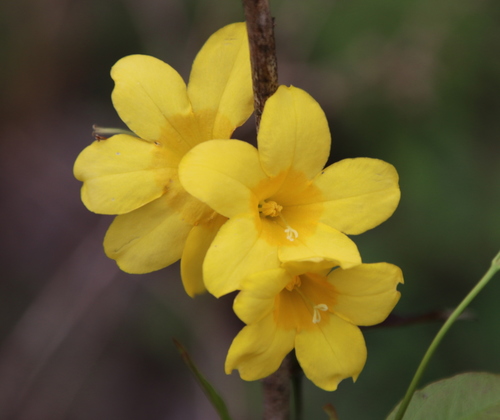
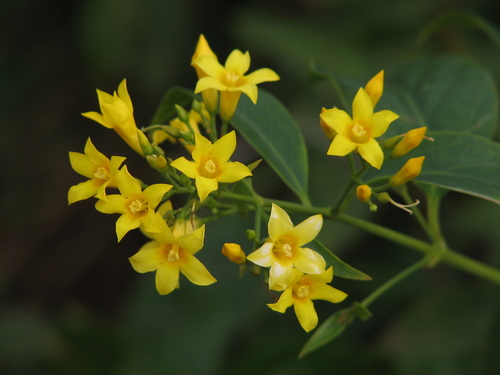
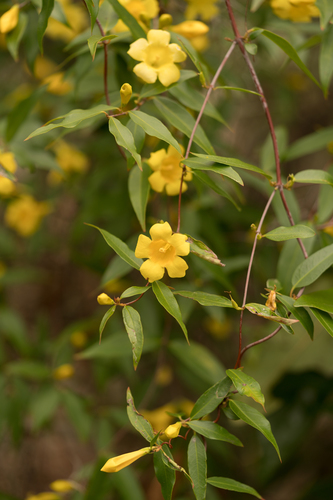
Gelsemium sempervirens (L.) J.St.-Hil. is a twining vine that belongs to the Gelsemiaceae family. It is native to subtropical and tropical America, specifically Honduras, Guatemala, Belize, the Mexican states of Chiapas, Oaxaca, Veracruz, Puebla, and Hidalgo, as well as southeastern and south-central United States ranging from Texas to Virginia. This species has many common names: yellow jessamine, confederate jessamine, confederate jasmine, Carolina jasmine, Carolina jessamine, evening trumpetflower, gelsemium, and woodbine. Yellow jessamine is the official state flower of South Carolina. Despite its common name references to jasmine, this species is not a true jasmine and does not belong to the genus Jasminum. All parts of Gelsemium sempervirens contain gelsemine and gelseminine, toxic alkaloids related to strychnine, so the plant should never be consumed. Contact with the plant's sap may cause skin irritation in people with sensitive skin. Children have been poisoned after sucking nectar from this plant's flowers, mistaking them for honeysuckle. Nectar from this plant is toxic to honeybees; if honeybees gather this toxic nectar, it can cause brood death. However, the nectar may be beneficial to bumblebees. Studies show that bumblebees fed gelsemine had a reduced load of the parasite Crithidia bombi in their fecal matter after 7 days, though this difference was no longer significant after 10 days. A reduced parasite load improves bumblebee foraging efficiency, and pollinators may selectively collect otherwise toxic secondary metabolites as a form of self-medication. The plant is also known to be lethal to livestock. Despite its toxicity, Gelsemium sempervirens is a popular garden plant in warmer regions, where it is often trained to grow over arbors or cover walls. In the United Kingdom, this plant has earned the Royal Horticultural Society's Award of Garden Merit. It can be grown outdoors in mild and coastal areas of the UK, tolerating temperatures down to a minimum of −5 °C (23 °F); in other parts of the UK, it must be grown under glass. It requires a sheltered growing position in full sun or light shade.