About Gelochelidon nilotica (J.F.Gmelin, 1789)
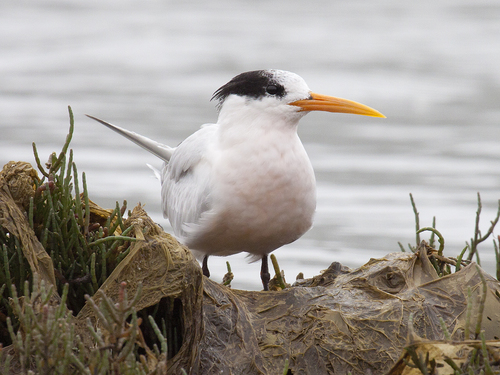
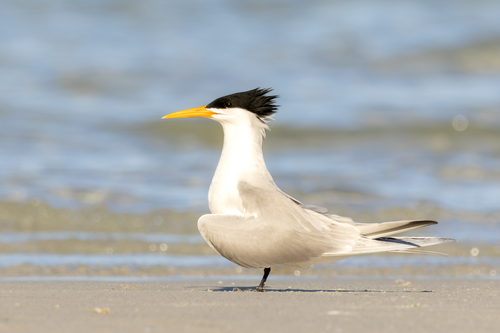
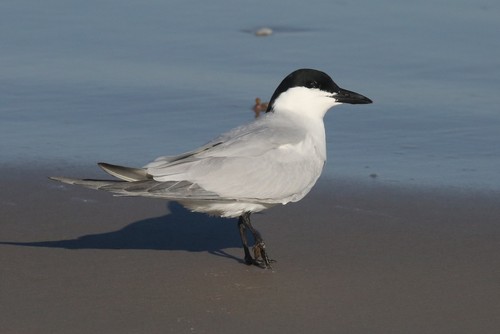
This is the description of the gull-billed tern, with the scientific name Gelochelidon nilotica (J.F.Gmelin, 1789). This is a fairly large, powerful tern that is similar in size and general appearance to a Sandwich tern, but can be distinguished by its distinctive short thick gull-like bill, broad wings, long legs and robust body. Summer adult individuals have grey upperparts, white underparts, a black cap, a strong black bill and black legs. Their characteristic call is described as ker-wik. This species measures 33–42 cm (13–17 in) in length, has a wingspan of 76–91 cm (30–36 in), and a body mass ranging from 150–292 g (5.3–10.3 oz). In winter, adults lose their black cap and develop a dark patch through the eye, similar to that seen on a Forster's tern or a Mediterranean gull. Juvenile gull-billed terns have a fainter mask than winter adults, but otherwise closely resemble winter adults. Juvenile Sandwich terns have short bills, and are frequently mistaken for gull-billed terns in areas where gull-billed terns are uncommon, such as North Sea coasts. This species breeds in warmer regions across the globe: southern Europe, temperate and eastern Asia, both coasts of North America, and eastern South America. There are a number of geographical races of this bird, that differ mainly in size and minor plumage details. All forms of this tern undergo post-breeding dispersal. Northern breeding populations are the most migratory, migrating south to winter in Africa, the Caribbean, northern South America, southern Asia, and New Zealand. The gull-billed tern is one of the species covered by the Agreement on the Conservation of African-Eurasian Migratory Waterbirds (AEWA). This is a somewhat atypical tern. While it resembles Sterna terns in appearance, its feeding habits are more similar to those of Chlidonias marsh terns, including the black tern and white-winged tern. Unlike most other white terns, it does not normally plunge dive to catch fish, and has a broader diet than most other terns. It feeds largely on insects captured in flight, and also often hunts over wet fields and even brushy areas to catch amphibians and small mammals. It is an opportunistic feeder, and has been observed picking up and eating dead dragonflies from road surfaces.