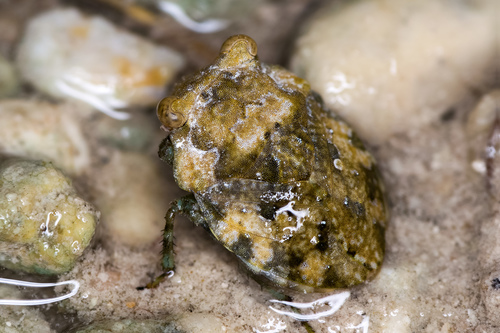
About Gelastocoris oculatus (Fabricius, 1798)
Gelastocoris oculatus, commonly called the big-eyed toad bug, is a species of toad bug belonging to the family Gelastocoridae. This species occurs across Central America and North America. North of Mexico, it is present in 28 continental United States and 3 Canadian provinces. It is a riparian insect, found near the shores of both freshwater lentic (still-water) and lotic (flowing-water) systems. It prefers damp substrates over fully saturated substrates. The species' coloration, body shape, and hopping behavior are similar to that of toads. Toad bugs rely on their cryptic coloration to blend into the sand, soil, or pebble-heavy substrates of their habitats to escape predators. They can leap distances many times their own body length to avoid predation, and are also capable of swimming short distances. Both adult and nymph G. oculatus capture smaller insects by jumping onto their prey, then consume prey using their piercing-sucking mouthparts. Females deposit their eggs under rocks, or within sand or mud, and nymphs go through 5 developmental instars before reaching adulthood. This species is most active from spring through autumn, and individuals living in the northern portion of its range hibernate. Adult big-eyed toad bugs are sometimes observed gathering in groups.