About Gelasimus vomeris (McNeill, 1920)
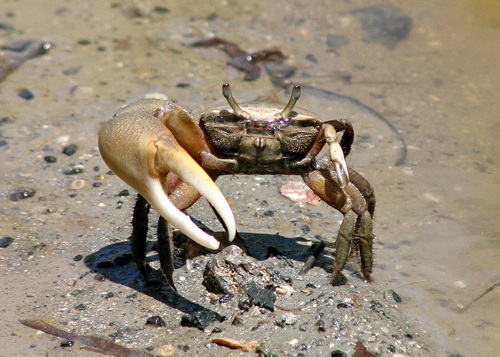
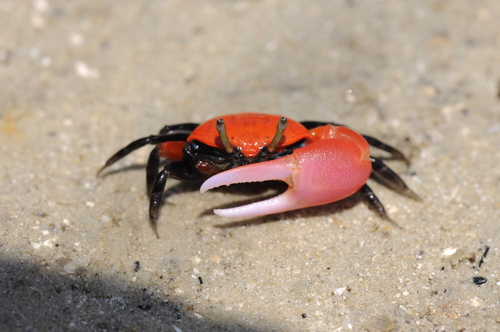
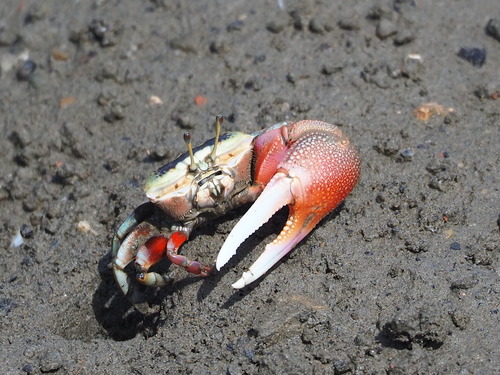
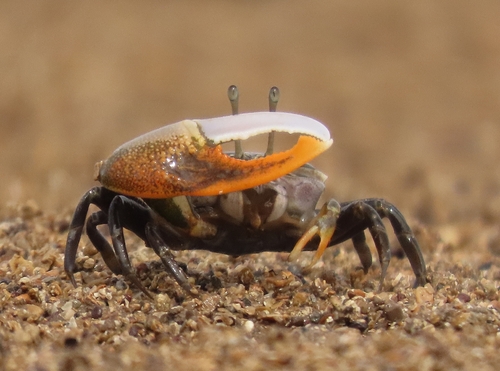
The carapace of Gelasimus vomeris reaches up to 30 millimeters across. Its base color is black-brown, with blue patches that vary in extent between individuals. Adult males have one greatly enlarged claw: the upper finger of this claw is grey or pink, while the lower finger and the main hand portion of the claw are orange. Like all other fiddler crabs, males use this enlarged claw to scare or fight other rival males, and perform waving displays with it to attract female mates. On the lower finger of the male claw, there is a large triangular protective structure at the section farthest from the crab’s body. When individual Gelasimus vomeris crabs are caught, their coloration becomes less bright within a few minutes. If predators are present in the crabs’ habitat, their blue color changes gradually over several days to a dull, muddy brown. This species prefers unshaded sandy mud as its habitat. It occurs in bays, estuaries, and creeks, where individuals live in burrows located at lower tide levels. While feeding, crabs stay within 1 meter of their own burrows on average. In established colonies of this species, there is a strong predominance of individuals with the enlarged claw on their right side. One study found that left-clawed individuals made up only 1.4% of the studied population.