About Gehyra versicolor Hutchinson, Sistrom, Donnellan & Hutchinson, 2014
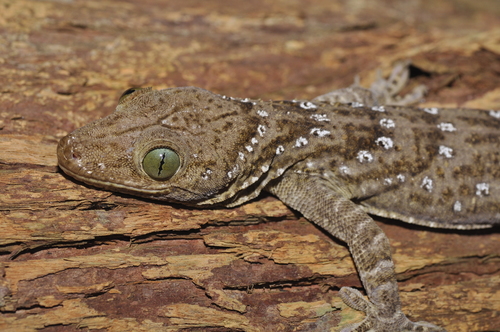
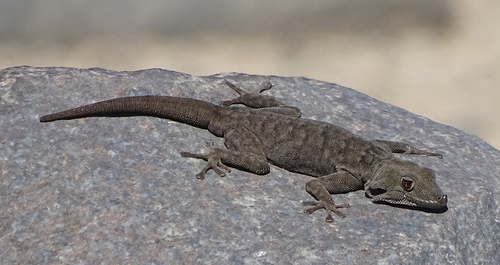
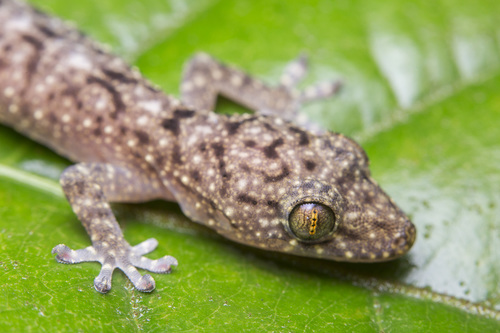
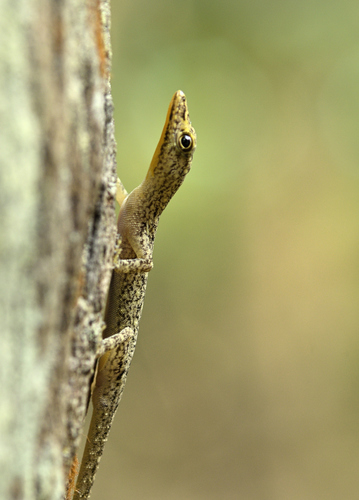
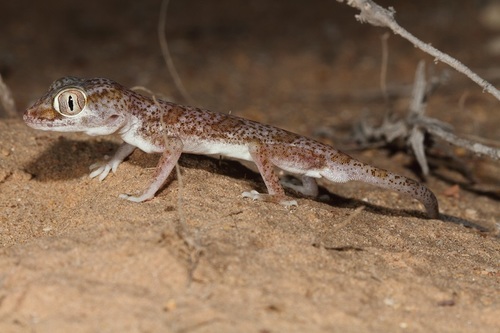
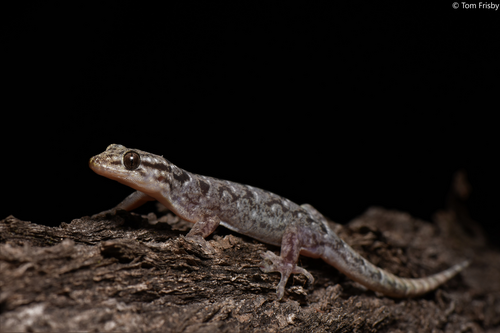
Gehyra versicolor is a medium-sized gecko with base coloration ranging from medium grey to brown, marked with complex dark and white patterns. Faint to prominent white spots or short lines can appear along the posterior margins of the dark markings. This species has a flattened body, with toe pads at the end of each toe, and 8 to 11 pairs of supralabial scales. The maximum recorded body length of this species is 57mm; adult snout length ranges from 37 to 54mm, and the tail length of a full-grown individual ranges from 40 to 58mm. Gehyra versicolor is extremely difficult to distinguish from Gehyra variegata using external morphology alone, because the two species share the same external physical characteristics. Instead, the two species are differentiated by differences in karyotype and distribution. Gehyra versicolor is widespread across eastern Australia. Its range extends from northern Victoria, through the Great Dividing Range in New South Wales, and north into North Queensland. To the west, its range covers most of South Australia and extends into the central Northern Territory. This species does not occur in Western Australia or Tasmania. Gehyra versicolor depends on native, mature woody vegetation for its habitat. Its widespread semi-arid macrohabitats are most commonly classified as dry woodland, desert woodland, or savannah woodland, and are frequently composed of Red Gum, Pine-Buloke, Mallee, or Black Box Woodland. Its microhabitat is defined by the presence of thick peeling bark, fallen logs, fallen timber, leaf litter, and rocks. The species is both arboreal and saxicoline, and uses both ground and mid-canopy habitats. Male and female Gehyra versicolor reach sexual maturity at 2 years of age, but do not start breeding until they reach 3 years old. Females lay one egg twice per year: the first egg is laid in late spring, and the second in mid-summer. Eggs are laid away from the adults’ habitat, typically under protective cover such as logs, bark, or rock formations. Eggs hatch approximately 60 to 80 days after being laid.