About Gehyra mutilata (Wiegmann, 1834)
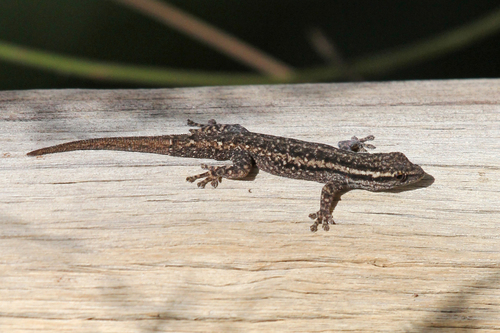
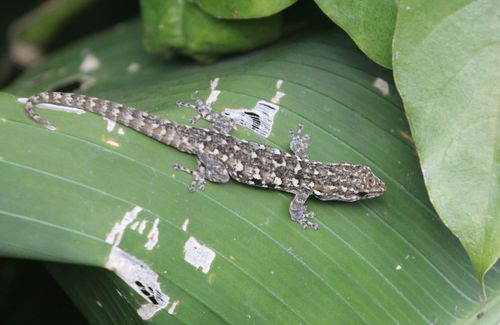
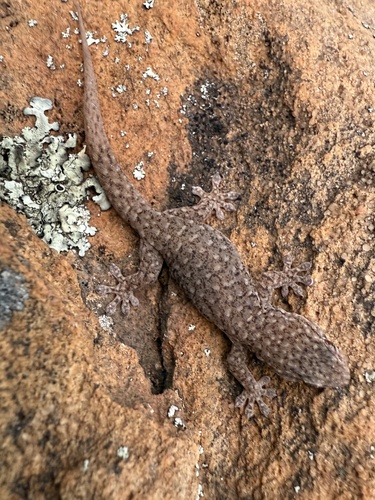
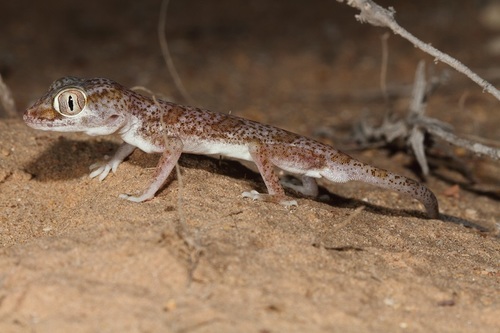
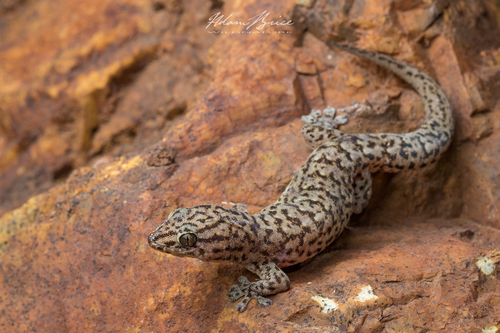
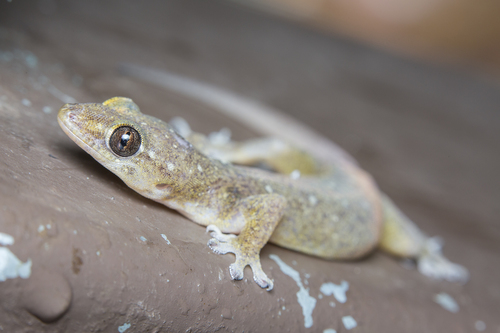
Gehyra mutilata (Wiegmann, 1834) has a head that is longer than it is broad. Its snout is longer than the distance between the eye and the ear-opening, and measures approximately 1.3 times the diameter of the orbit. A median groove is present on the forehead. The ear-opening is moderately large and suboval in shape. The body and limbs are moderately elongate and depressed, with a fold of skin running along the posterior border of the hind limb. Digits are short and more or less webbed at the base. The inferior lamellae are angular and divided by a median groove. The upper body surface and throat are covered with small granular scales; these scales are largest and flat on the back. Abdominal scales are moderate in size. The rostral scale is quadrangular, broader than it is deep, with a median cleft along its upper edge. The nostril is pierced between the rostral, the first labial, and three nasal scales; the uppermost nasal is much the largest, and generally contacts the opposite upper nasal. There are 8 or 9 upper labial scales, and 6 or 7 lower labial scales. The mental scale is moderately large and pentagonal. There are 3 pairs of chin shields: the innermost pair is very large and elongate, while the outermost pair is small and frequently broken up into smaller scales. Femoral pores are arranged in a doubly curved line that is angular in the middle, with 14 to 19 pores on each side. The tail is depressed, and normally has a sharpish, minutely serrated lateral edge. The upper surface of the tail is covered with very small flat scales, while its lower surface generally has a median series of large transversely dilated scales. The species is greyish or reddish brown on its upper side, and may be uniformly colored, dotted, or variegated with darker tones. Lower surfaces are uniformly whitish. Adult Gehyra mutilata may reach a snout-to-vent length (SVL) of 2.25 inches (5.7 cm), with a tail length equal to the SVL. A key identification trait for this species is the absence of a claw on the innermost digit. This species is widely distributed across Borneo, southeastern China, French Polynesia, Maui (Hawaii), India, Indonesia, Malaysia, Singapore, the Mascarene Islands, western Mexico, Myanmar, Thailand, New Guinea, the Philippines, the Pitcairn Islands, Seychelles, and Sri Lanka. Like many other geckos, Gehyra mutilata is highly adaptable to its surroundings, though it typically prefers woodlands, rocky areas, and human dwellings, occurring at altitudes from sea level up to 1,400 m (4,600 ft). It is very common on sand beaches in Hawaii, where it is classified as an invasive species. It readily settles in human homes and does not avoid cohabiting with people, and most people do not object to its presence, likely because it is a nocturnally active species that spends most of its time high on walls and ceilings. It is quite unobtrusive, and preys on household insects. Like many gecko species, Gehyra mutilata can produce sounds for communication. Its call, which sounds like "tock", is repeated six to eight times with increasing volume. It is also capable of running faster than other house geckos. Gehyra mutilata is often compared to the common gecko Hemidactylus frenatus in terms of habitat use; it is often reported that G. mutilata will not be found in areas where H. frenatus occurs, though this pattern can vary by location. Gehyra mutilata is oviparous. Clutch size ranges from one to three eggs, and is most commonly two.