About Gecarcinus ruricola (Linnaeus, 1758)
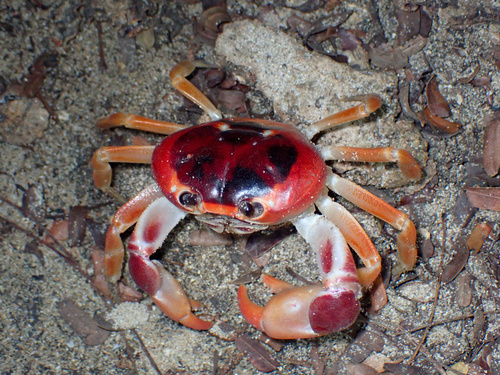
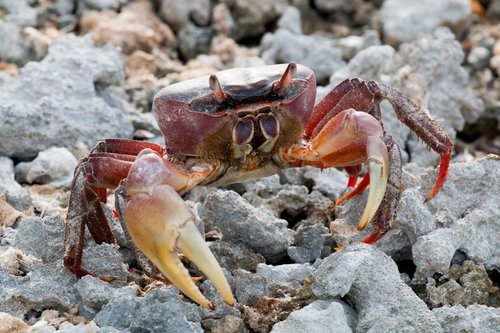
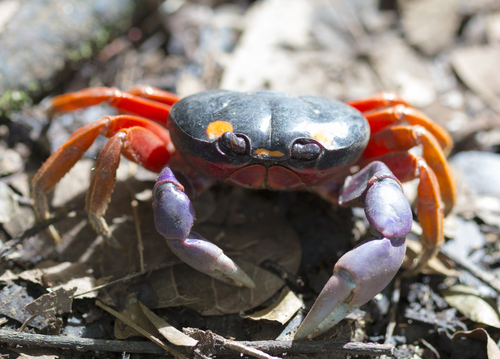
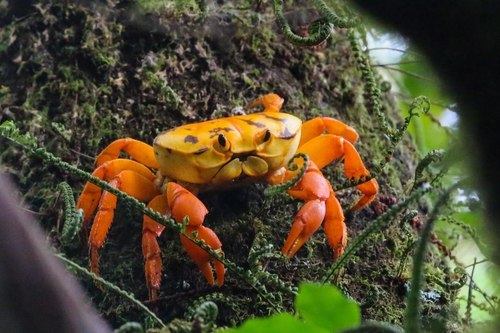
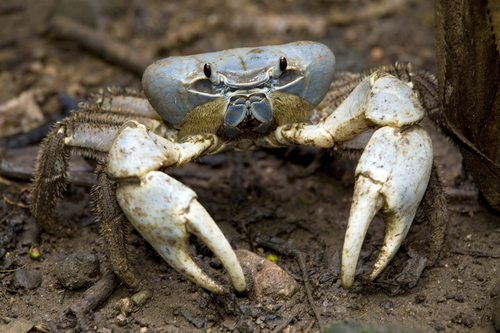
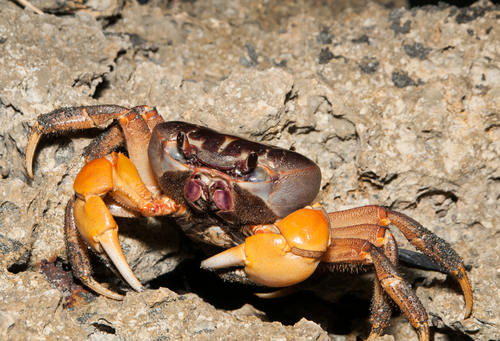
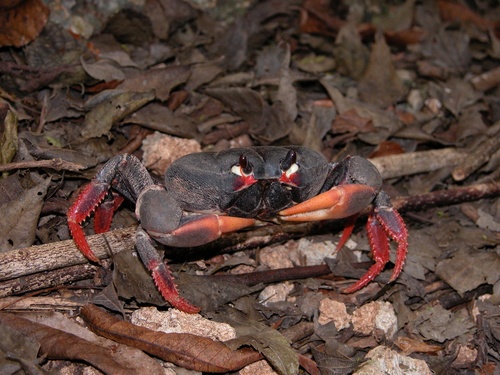
Four distinct colour morphs exist in Gecarcinus ruricola: black, red, yellow, and green. The width of the species' carapace grows at an average rate of 1 inch (25 mm) per year. Individuals reach maturity after 5 years, and can live up to 10 years total. G. ruricola has multiple adaptations for terrestrial life, most centered on water conservation. It is nocturnal, which keeps the hot sun from drying out its body. It also possesses a 'nephritic pad'; urine is released onto this pad, where microbes clean it before the water is reabsorbed back into the body. G. ruricola is distributed across most of the Caribbean, ranging from Cuba and the Bahamas in the west through the Antilles to Barbados in the east. While it has been recorded in Florida and Nicaragua, there are very few confirmed mainland occurrences. The northernmost point of the species' island distribution is Loggerhead Key in the Dry Tortugas, and the full island range extends across the Bahamas and Cuba, through the Greater and Lesser Antilles, to Barbados. Isolated outlying populations are found on Curaçao, in the Swan Islands off Honduras, at Half Moon Caye in Belize, and in the Archipelago of San Andrés, Providencia and Santa Catalina off the coast of Colombia. The species can be found far from the sea and at high elevations: it has been observed above 300 m (980 ft) on Dominica, and at over 1,000 m (3,300 ft) on Jamaica. Eggs of G. ruricola hatch in the sea, where larvae live as plankton. Larvae do not return to land very often, but when they do return as megalopa larvae, they do so in numbers large enough to turn roads red. They move at speeds between 1 and 2 m/s (2.2–4.5 mph), and can move faster when startled. For their first three years, young crabs live in burrows occupied by older crabs, and feed on food the older crab brings back to the burrow. After mating, the species engages in mass migrations, with females traveling back to the sea to release their fertilized eggs. An average female G. ruricola carries approximately 85,000 eggs. G. ruricola is an omnivorous scavenger, and feeds primarily on nitrogen-poor plant matter. The meat of this crab is high in protein, and has long been harvested by local people. Birds may act as predators of G. ruricola, though little information is available on this topic. When threatened, G. ruricola rears up and holds its open claws outward in a defensive posture.