About Gecarcinus quadratus de Saussure, 1853
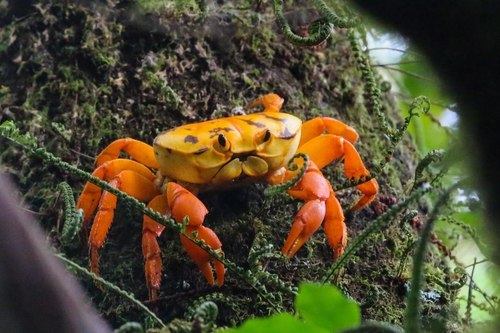
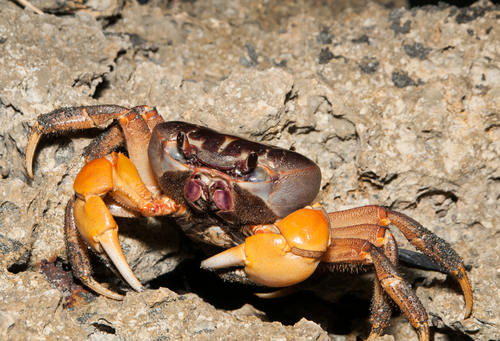
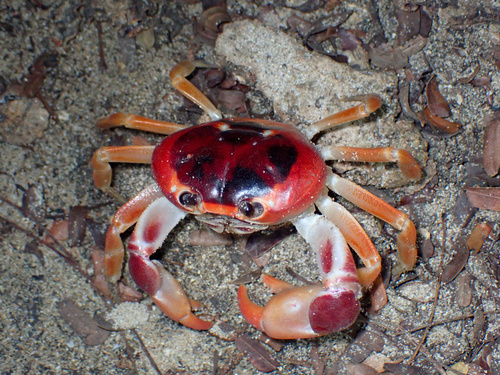
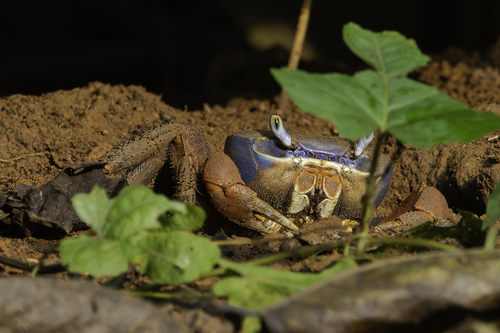
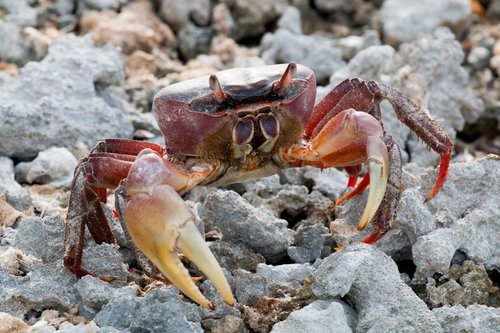
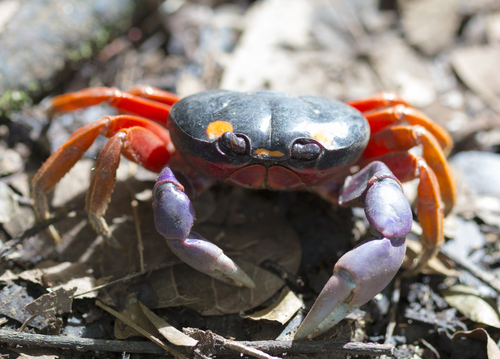
Gecarcinus quadratus has unique morphological features that set it apart from other closely related species in the family Gecarcinidae. The carapace of this species is typically transversely oval, most often dark purple or black, and measures between approximately 2.7 to 5 cm (1 to 2 inches) across. Three main traits identify this species’ shell: a pair of whitish spots on the central-lower carapace, a pair of distinct yellow or orange spots positioned behind the orbitals, and a single orange spot located directly between the orbitals. The underside and walking legs of G. quadratus are lighter in color, usually ranging from light orange to nearly red, while the chelipeds can be various shades of purple. Gecarcinus quadratus is distributed along the Pacific coasts of the Americas, ranging from the Gulf of California south through Mexico and Costa Rica to Peru, and along the western Atlantic coast from Florida and Bermuda through the Antilles and Central America to Guyana. G. quadratus inhabits the coastal rainforests of Mexico and Central America, and is common along the coasts of Mexico, Costa Rica, Panama, and Nicaragua. Although it cannot swim, it is always found near water and moist environments, so it spends most of its time on land in these forests and mangroves. This is a nocturnal crab that digs burrows, which can sometimes reach 1.5 m (4.9 ft) in length. It is largely herbivorous, feeding on leaf litter and seedlings.