About Geastrum triplex Jungh.
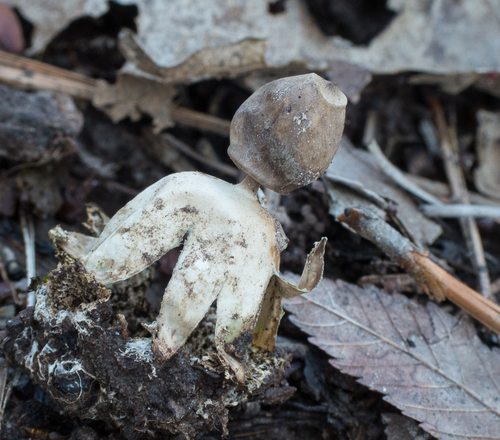
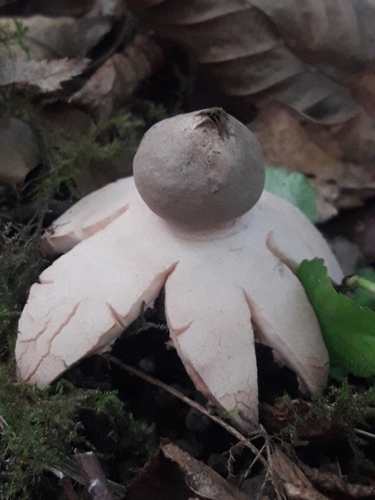
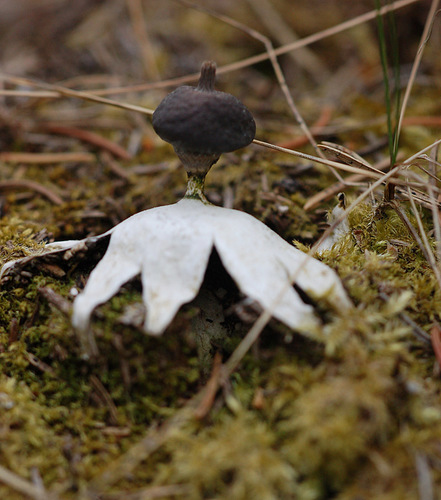
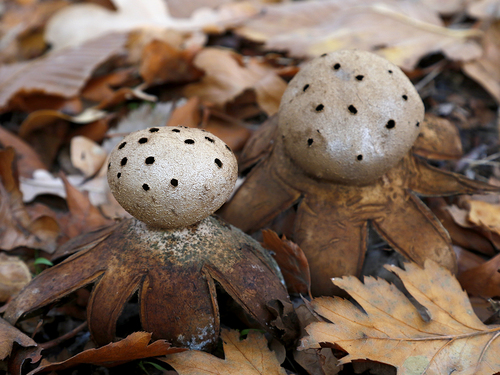
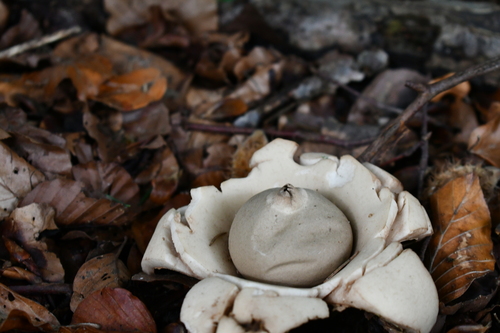
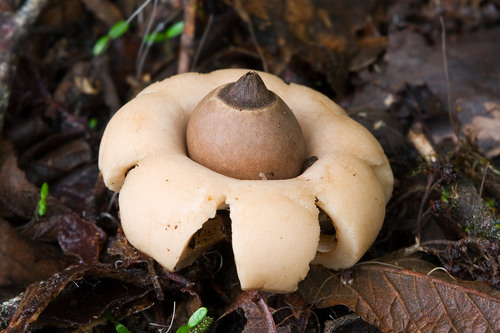
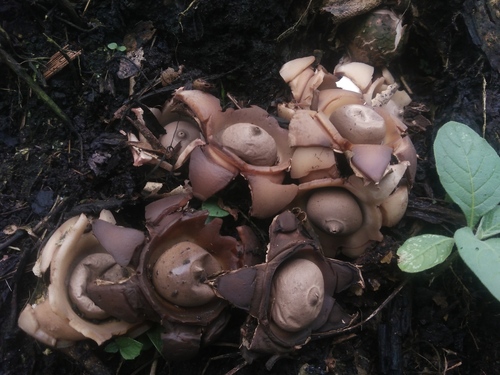
Like all fungi, the visible fruit body of Geastrum triplex is part of a larger hidden organism. Masses of nearly invisible fungal threads called mycelium make up the fungus’s active feeding and growing structures, which stay hidden from view. Fruit bodies form when environmental conditions such as temperature, moisture, and nutrient availability are optimal, and their function is to produce and spread spores. Geastrum triplex has the largest fruit bodies of all earthstar mushrooms. Immature fruit bodies typically measure 1 to 5 cm (1⁄2 to 2 in) in diameter; when the rays are spread out, mature fruit bodies can reach 8 to 10 cm (3+1⁄4 to 4 in) across, and may exceptionally grow to 11.5 cm. The fruit body has a roughly spherical to egg-shaped inner structure called the endoperidium, which is topped by an opening called the ostiole. The ostiole is covered by tissue fragments that form a small pointed beak called a peristome. The endoperidium is typically sessile, meaning it has no stem. It is grayish brown to wood brown when young, and light yellow-brown in dried, unopened specimens. The outer tissue layer, called the exoperidium, develops splits that radiate from the apex and form between four and eight rays that separate from the endoperidium. The endoperidium is a thin, papery envelope that surrounds a mass of spores and fertile tissue called the gleba. The central part of the gleba contains a pseudocolumella, which is a column-like structure not attached to a stalk. It is typically cylindrical or club-shaped and extends upward from the base; it has limited value for identification because its persistence, size, structure, and shape vary widely within the genus. The rays of the exoperidium are 2 to 4 cm (3⁄4 to 1+1⁄2 in) long and up to 4 mm (3⁄16 in) thick. The outer surface of the rays, which becomes the lower surface after the fungus expands, and the surface of unopened specimens have a rough texture. Unlike many other Geastrum species, dirt and debris do not adhere to the underside of G. triplex rays. When dried, the inner fleshy upper surface of the rays is wood brown, and its outer tissue layer cracks into patches. The extent of this cracking varies a great deal: the tissue layer may stay closely attached as a sheet over the unsegmented part of the outer wall, while the portion attached to the rays cracks to varying degrees, sometimes peeling off completely in spots. In G. triplex, the bases of the rays usually break around the perimeter of the endoperidium to form a saucer-shaped platform or receptacle that holds the endoperidium. However, not all specimens develop this receptacle, which can lead to confusion with other Geastrum species. Naturalist Curtis Gates Lloyd proposed that in tropical regions with abundant high heat and humidity, the fungus expands rapidly, which makes it more likely for the fleshy layer to break away and form a receptacle; in more temperate areas, this effect is less pronounced, and usually does not occur at all. The endoperidium is 1 to 3 cm (3⁄8 to 1+1⁄8 in) in diameter, 0.9 to 2 cm (3⁄8 to 3⁄4 in) high, sessile, and a dull grayish brown. The peristome is made of radially arranged fibrils that clump together at the apex in groups of unequal length, creating an opening that looks jagged or torn. The circular area bordering the peristome is paler in color. Microscopically, the spore sac (endoperidium) contains the gleba, which is made up of a pseudocolumella, unbranched threads called capillitium, spore-bearing cells called basidia, and the spores themselves. All these microscopic elements have distinct features that help distinguish G. triplex from other superficially similar earthstars. Spores are dispersed by wind, which sucks spores out of the opening when it blows across the ostiole, or by falling raindrops that hit the flexible endoperidium, creating a puff of air that forces spores out through the opening. The spores are spherical, 3.5–4.5 μm in diameter, and covered with short, narrow projections that end abruptly, made of a translucent (hyaline) substance. The spores turn pale cinnamon brown when treated with potassium hydroxide, and dark dull brown (nearly sepia) when stained with iodine. The capillitium consists of apparently encrusted cylindrical filaments 3–6 μm in diameter. In potassium hydroxide, their color ranges from hyaline to dull yellowish brown, and they turn yellowish in iodine. Their walls are thickened enough that the inner lumen appears as only a thin line. Basidia have either two or four spores attached, and the sterigmata (extensions of the basidia that hold the spores) are long, up to 20 μm. Geastrum triplex does not produce cystidia. Geastrum triplex is a saprobic fungus, meaning it gets nutrients from decomposing organic matter. Its fruit bodies usually grow singly, or more commonly in groups, in hardwood forests with accumulated humus; in Mexico, specimens have been collected in tropical deciduous forest. Fruit bodies are often found around well-rotted tree stumps. They start almost buried in loose duff, but emerge as they mature when the downward curling of the rays exposes the spore sac. Old fruit bodies are persistent, and may survive the winter to be found the following spring or summer. A Dutch study noted that G. triplex tends to grow on calcium-rich soil formed from washed-out chalk of crushed shells along bicycling paths. It is described as common in North America and Europe, and one author notes it is commonly found growing under beech trees. Geastrum triplex has a widespread distribution, and has been collected in Asia (China, Korea, Iran, and Turkey), Australia, Europe (Belgium, Czech Republic, Sweden, and the Canary Islands), Africa (Congo, South Africa), North America (from Canada in the north to Mexico in the south, including all of the continental United States and Hawaii), and Central and South America (Panama, Trinidad and Tobago, Argentina, Brazil, and Chile. Earthstar mushrooms including this species were used medicinally by indigenous peoples of the Americas. The Blackfoot people called G. triplex ka-ka-toos, meaning "fallen stars", and legend holds that they indicate supernatural events. The Cherokee people placed fruit bodies on newborns’ navels after childbirth, until the withered umbilical cord fell off, using the fungus both as a prophylactic and therapeutic measure. In traditional Chinese medicine, G. triplex is used to reduce inflammation of the respiratory tract, stanch bleeding, and reduce swelling.