About Geastrum saccatum Fr.
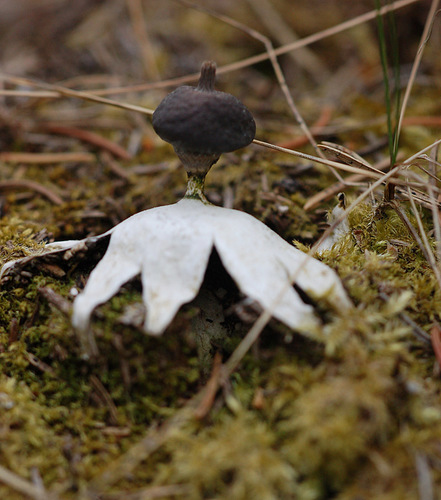
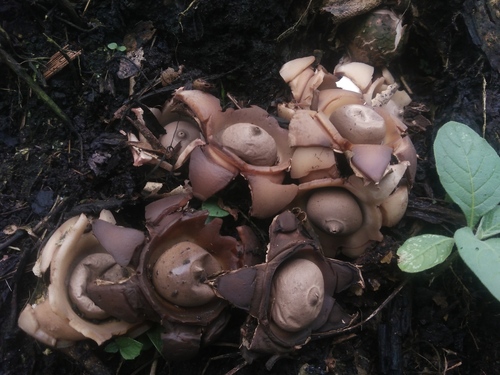
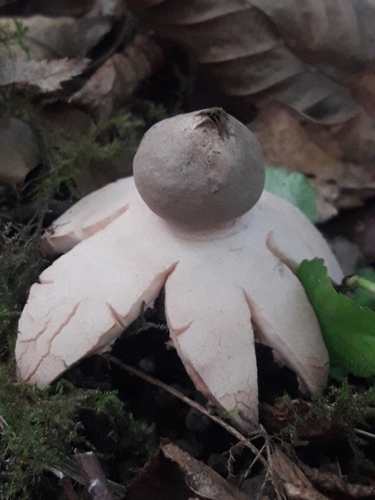
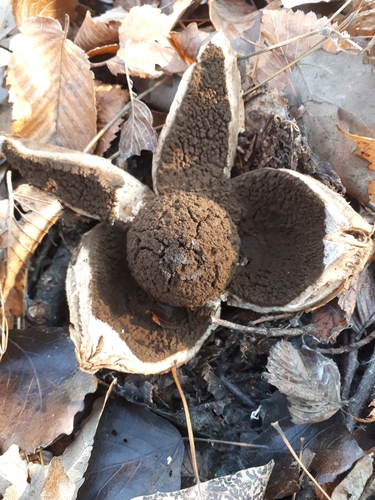
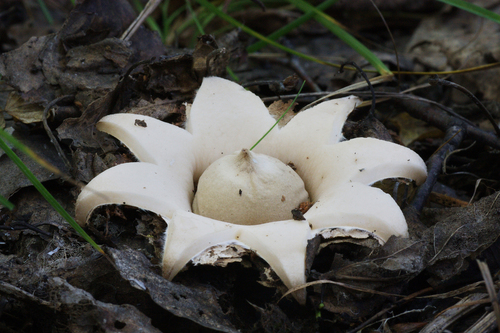
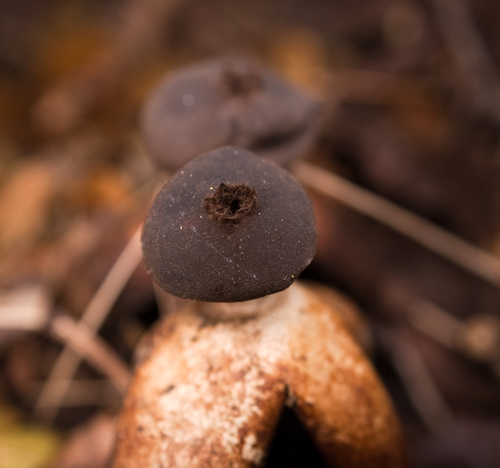
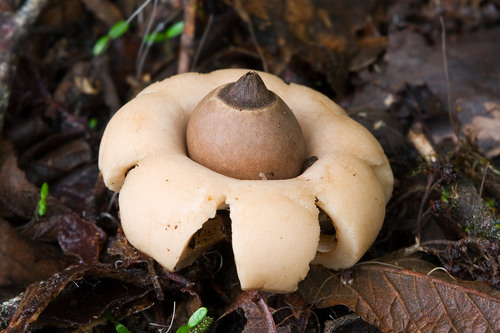
Immature fruiting bodies of Geastrum saccatum measure 0.6 to 2.5 centimetres (1⁄4 to 1 in) in diameter, and 0.8 to 1.5 cm (3⁄8 to 5⁄8 in) tall. Young fruiting bodies are egg-shaped, similar in appearance to puffballs, and have strands of mycelia called rhizomorphs at the base that attach the fungus to its growing surface. The outer skin of the fruiting body, called the peridium, is made of two separate layers. The outer layer, the exoperidium, is golden tan to yellowish-brown; it separates from the inner basidiocarp and splits into five to eight rays that curve backward (recurve) toward the base. After the rays expand, the whole fungus reaches 2 to 5 cm (3⁄4 to 2 in) in diameter. Unlike some other species in the genus Geastrum, such as G. fornicatum, the expanded rays do not lift the inner basidiocarp off the ground; instead, the basidiocarp remains lying flat. The inner spore-bearing basidiocarp is 0.5 to 2 cm (1⁄4 to 3⁄4 in) wide, and has a central pore surrounded by a circular dull-brown apical disc; this disc is distinctly ridged or depressed. The interior of the central spore-bearing sphere is white when young, but matures into a mass of brown, powdery spores mixed with thick-walled fibres called capillitium. The flesh of the fungus has a bitter taste. Geastrum saccatum is saprobic, and grows either scattered or clustered in leaf litter and humus, usually during late summer and fall. It has a cosmopolitan distribution, is well adapted to tropical regions, and is common in Hawaiian dry forests. It has been collected in North America (Canada, the United States and Mexico), Central America (Panama), South America (Argentina, Uruguay, and Brazil), Cuba, Africa (the Congo, Tanzania, West Africa, and South Africa), Asia (China and India), Tobago, and Toowoomba, QLD, Australia. In North America, it appears from September to December on the west coast, and from July to October elsewhere. Geastrum saccatum is inedible when mature, which is the growth stage it is most commonly found in.