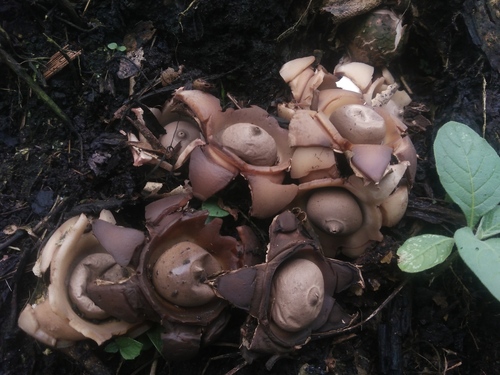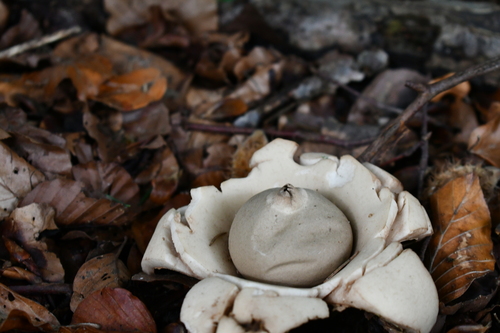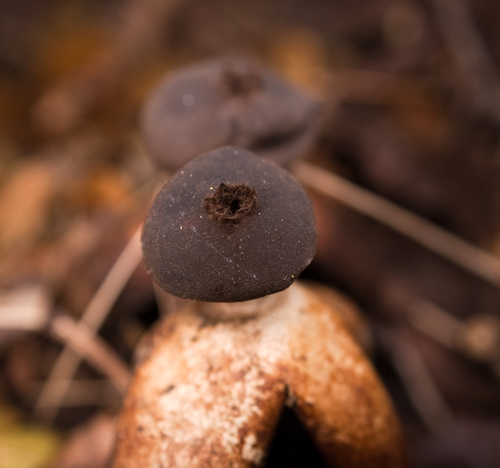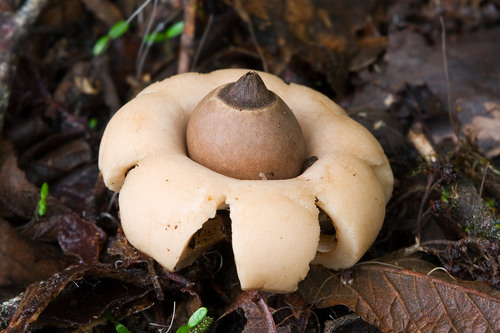
About Geastrum quadrifidum Pers.
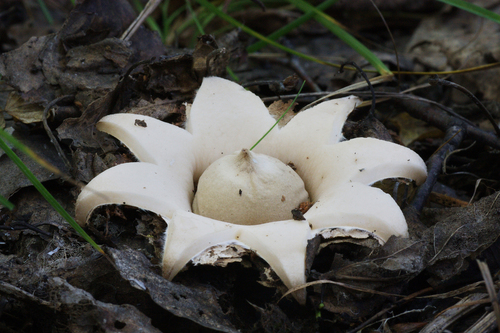
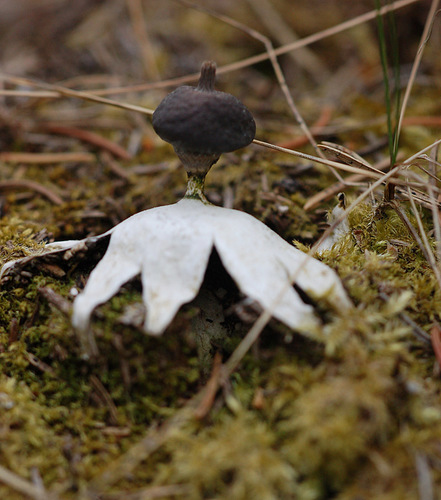
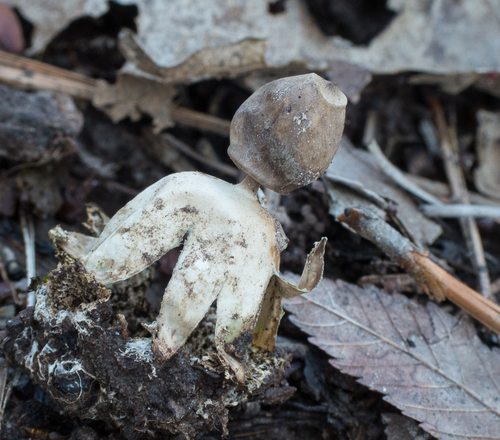
Like all Geastrum fungi, Geastrum quadrifidum Pers. has an internal spore-producing gleba enclosed by a four-layered protective peridium. These four layers are the inner endoperidium, and the outer exoperidium, which is further divided into an external mycelial layer, a tough membranous middle fibrillose layer, and an internal fleshy layer called pseudoparenchyma. Immature, unopened fruit bodies are roughly spherical to somewhat flattened or irregular in shape. They lie partly or completely submerged, encrusted with surrounding debris. Expanded fruit bodies are typically taller than they are wide, measuring 10–40 mm (3⁄8–1+5⁄8 in) high; when the mycelial cup is included, total height ranges from 15–55 mm (5⁄8–2+1⁄8 in). The exoperidium, the outer layer of the four-layered peridium, splits from its center into three to six rays, most commonly four or five. The exoperidium is typically fornicate: this forms when the mesoperidium separates from the exoperidium, only adhering at the edge. This process lifts the endoperidium (the inner tissue layer enclosing the spore sac) upward as the rays move downward. In this species, ray tips stay attached to the mycelial layer, which remains anchored to the substrate as a cup in the ground. Unlike rays of some other Geastrum species, the rays of G. quadrifidum are not hygroscopic—they do not open or close in response to changes in humidity. Rays are generally broad, but may appear narrow because their edges often roll inward. The width of the exoperidium (when still attached to the mycelial cup) is 8–25 mm (3⁄8–1 in), and 15–90 mm (5⁄8–3+1⁄2 in) when fully expanded. When fresh, the pseudoparenchymatous layer is 1–2 mm thick. It starts out whitish, later turns beige to brownish (sometimes with reddish overtones), and becomes dark brown when old. In newly expanded specimens, this layer is covered with a thin layer of crystals and hyphae, sometimes forming a pseudoparenchymatous cup or collar that often peels off in patches; it shrinks and hardens when dry. The fibrous layer has a papery to leathery texture. When free of pseudoparenchymatous remnants, the inner side is almost white, becoming dirty grayish-white with age and sometimes greenish from algal growth. The outer side is initially whitish and somewhat glossy, turning grayish-white and dull with age. The mycelial layer has a whitish inner side and is strongly attached to surrounding litter on its outer side. It persists for a long time; 1–2-year-old fruit bodies with intact mycelial cups have been found. The spore sac varies in shape from roughly spherical to egg-shaped or irregular, but it is usually taller than it is wide. Its diameter ranges between 3.5 and 16 mm (1⁄8 and 5⁄8 in), and most commonly between 5 and 10 mm (3⁄16 and 3⁄8 in). An apophysis, a swelling on the underside of the spore sac, is often present. The stalk becomes visible after the pseudoparenchymatous layer dries; it is short but distinct, measuring 1–2.5 mm tall. Its color is variable, and dry specimens are whitish, light beige, beige gray, smoky gray or brownish-gray. The endoperidium of newly expanded fruit bodies is pruinose, meaning it is covered in a light beige to whitish powder made of hyphae and crystalline matter. This powder gradually disappears as the fruit body ages. Endoperidium color varies widely, with both light and dark forms occurring. The peristome, a clearly defined region surrounding the spore sac's opening, is distinctly delimited, and ranges from disc-like to more or less conical in shape. It is lighter in color than the spore sac, and grows up to 2 mm high. In old specimens, hyphae around the peristome sometimes stick together to form radial grooves. Peristome color varies, but it often has grayish or grayish-brown tints and is usually lighter than the endoperidium. The columella, a mass of sterile tissue that typically originates at the base of the gleba and extends into or through it, is underdeveloped. It is roughly columnar to club-shaped, growing from a more or less bulge-like extension of the stalk, and intrudes about half or more into the mature gleba. Mature gleba is dark brown. G. quadrifidum is inedible. For microscopic characteristics: the basidia of G. quadrifidum either have a basal clamp connection, or narrow into a hyphal segment that ends at a clamp. Young basidia are roughly ellipsoid to club-shaped. With age, they often become roughly bottle-shaped, ampullaceous, or sometimes almost lecythiform, among other shapes. Mature basidia measure 14–21 x 4.5–7 μm, not including the hyphal segment. The hyphal segment measures less than 1–6 x 1–2 μm. Sterigmata, the thin basidia projections that attach to spores, are 4–6 μm long and mostly 1–1.5 μm thick. Hyphae located directly underneath the basidia are thin-walled, 1–2 μm wide, have clamps, and are densely branched. Hyphae of the tramal plates are roughly parallel, thin-walled, 1–2 μm wide, and have clamps that may be dilated. Mature spores are dark brown in mass. They are spherical, covered with warts (verrucae), and measure 5–6 μm in diameter including their surface ornamentation. Spores often contain an oil drop. Scanning electron microscopy shows the verrucae are up to 0.8 μm long, conical to columnar processes with rounded to nearly flattened tips. The apiculus, the part of the spore that attaches to the sterigma at the end of a basidium, is distinct and has radiating ridge-like processes. Young spores are first broadly egg-shaped before becoming roughly spherical at maturity. Capillitium is made of coarse, late-maturing, thick-walled cells in the gleba that develop pores or slits in their thick secondary walls. Capillitial hyphae are 1.5–9.5 μm wide, thick-walled, often with a narrow lumen, and may have or lack surface ornamentation. Columella hyphae are 1.5–14 μm wide (occasionally up to 34 μm wider), thick-walled, and often with a narrow lumen. Single thin-walled hyphae about 1.5 μm wide with clamps can be observed. Endoperidial hyphae are densely interwoven, thick-walled, and about 2–6 μm wide. The whitish powder on newly expanded specimens consists of crystalline matter and thin-walled, 1.5–4 μm wide, branched hyphae with clamps. Peristome hyphae are thick-walled, 2–11 μm wide. The pseudoparenchymatous layer is constructed from bladder-like, thin-walled hyphae of varying sizes. On the surface of newly expanded specimens, there are crystals and thin-walled hyphae of the same type found on the endoperidium. These crystals are calcium oxalate dihydrate with a pyramid-shaped crystalline structure. They are arranged singly or in loose aggregates, and measure 11 to 30 μm in size. The fibrous layer contains thick-walled hyphae 1.5–4 μm wide. The inner, very thin part of the mycelial layer, which appears as a glossy lining on the fibrous layer of newly expanded fruit bodies, consists of a dense web of thin-walled, 1.5–4 μm wide, clamped hyphae. Thick-walled hyphae are also present, measuring 2–11 (sometimes up to 19) μm wide. The outer part, which forms the mycelial cup, consists of thick-walled, branched and densely interwoven hyphae (often with a narrow lumen) that measure 1.5–4 μm wide. Regarding distribution, habitat and ecology: Although Geastrum quadrifidum has a wide distribution, it is not a common species. European countries where the fungus has been reported include Belgium, Denmark, France, Germany, Montenegro, Norway, Poland, and Sweden. In Asia, it has been collected in China and Japan. In North America, its distribution ranges from Canada south to Mexico, and it also occurs in Hawaii. It is also found in Australia and New Zealand, South Africa, and South America. Due to its rarity, it has been added to the Regional Red Lists of several European countries, including Montenegro, Denmark, Norway, and Poland. Like most earthstars, G. quadrifidum is a saprobic fungus. It spends most of its life cycle as thin mycelial strands, obtaining nutrients by decomposing leaf litter and similar detritus, converting this material into humus and mineralizing organic matter in soil. Fruit bodies are generally found in coniferous woodland, and appear in summer and autumn. In Mexico, it has been found in tropical thorn forest and pine-oak forest in the summer. In Britain, all collections have been made in beech forest growing on calcareous soil.