About Geastrum pectinatum Pers.
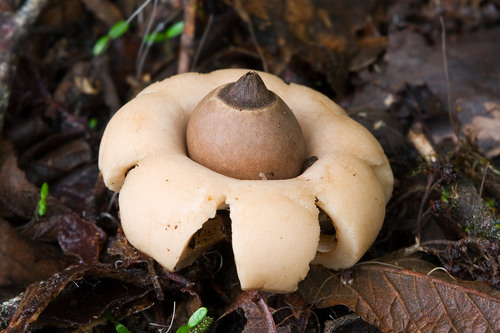
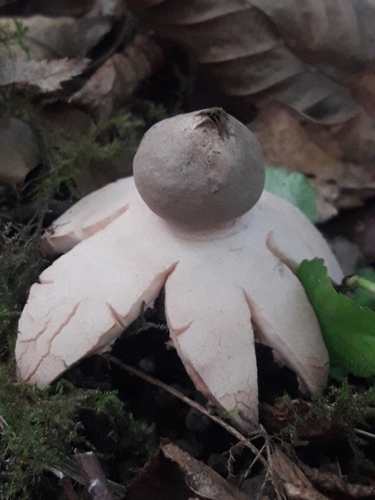
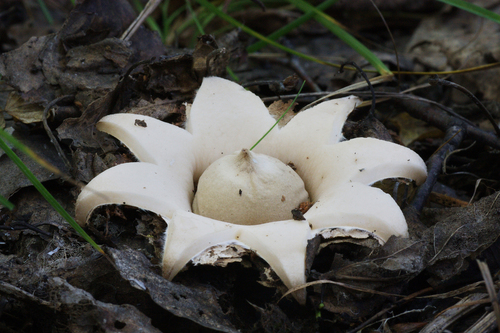
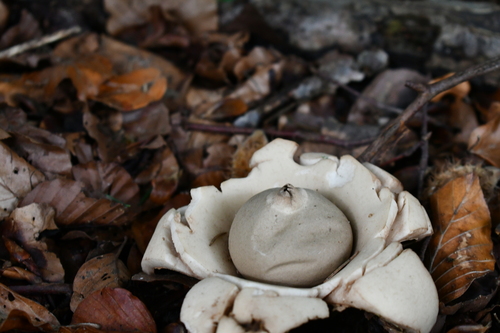
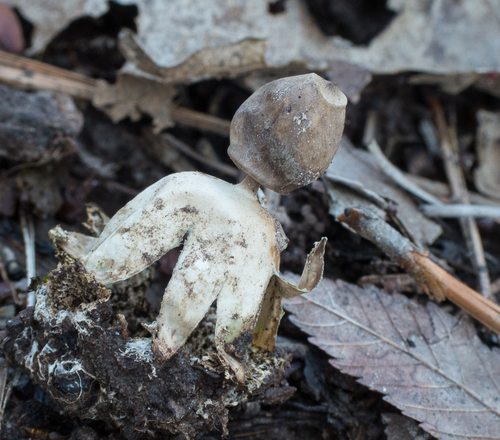
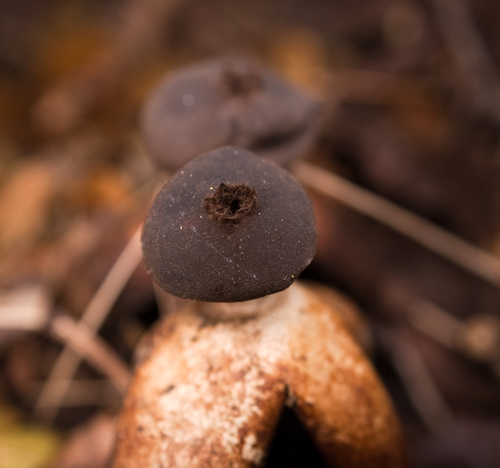
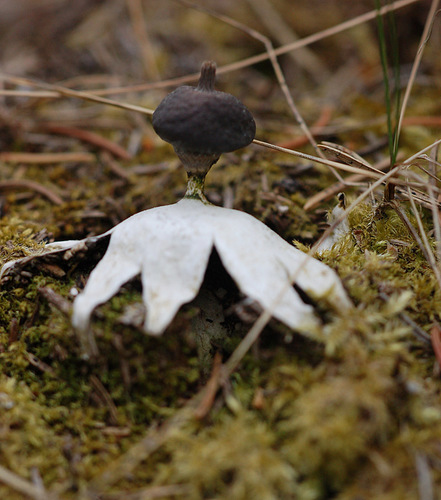
Geastrum pectinatum Pers. is an inedible earthstar mushroom species. Immature fruit bodies are 1 to 2 cm (1⁄2 to 3⁄4 in) across, roughly spherical, and start development underground, gradually emerging as they mature. The outer surface of young specimens is covered with mycelium that forms a soft, fluffy coat that traps soil and debris, and young fruit bodies often have a rounded knob or protuberance. Like other species in the genus Geastrum, the fruit body wall of G. pectinatum is multilayered. At maturity, the outer exoperidium splits open from the top in a star-shaped pattern into 7–9 rays that support the spore sac held within the inner endoperidium. Fully expanded mature specimens reach up to 5 cm (2 in) broad and 6 cm (2+1⁄4 in) tall. The exoperidium rays bend backward, elevating the spore sac above the ground in the fornicate condition, which exposes the spore sac to more air currents to help with spore dispersal. The surface of the rays often cracks to reveal lighter-colored areas, especially along the edges. The rays are usually bound to fragments of earth or forest duff along with a well-developed mycelial layer. The spore sac is made of tough, membranous purple-brown endoperidium, 0.5 to 1.5 cm (1⁄4 to 1⁄2 in) tall by 1 to 2.5 cm (1⁄2 to 1 in) wide, and is supported by a small stalk called a pedicel. The pedicel is 3–4 mm (1⁄8–3⁄16 in) long by 7–10 mm (1⁄4–3⁄8 in) wide, and has a grooved (sulcate) ring-shaped swelling called an apophysis made of remnants from the pseudoparenchymatous layer. When fresh, the pseudoparenchymatous layer is whitish, thick, and fleshy; when it dries, it turns brown to dark brown, shrinks, and often splits and peels. The endoperidium may be covered with fine, white powder (a pruinose coating), though this trait is somewhat variable. The spore sac opens via a single apical pore at the top of a conical beak-like peristome. The peristome is pectinate, meaning its structure resembles comb teeth; the species’ specific epithet is named for this characteristic. The peristome is 2 to 5 mm (0.08 to 0.20 in) long, and has 20–32 distinct ridges. The gleba, the mass of spores and surrounding cells inside the sac, is dark brown and becomes powdery in mature specimens. Inside the endoperidium, a narrowly conical structure called a columella extends more than halfway into the gleba; it is whitish or pale brown. G. pectinatum has no distinguishable odor or taste; it is inedible, and considered to have no alimentary interest. Microscopically, the spores of G. pectinatum are brown and opaque. They are roughly spherical, ornamented with transparent (hyaline) truncated warts, and measure 4–4.5 μm in diameter (5.5–6.5 μm if the warts are included). Spore-bearing basidia are 2- or 4-spored, and cystidia (specialized sterile hymenial cells found in some mushroom species) are absent. Capillitia, masses of thread-like sterile fibers dispersed among the spores, are light brown, 3–7 μm in diameter, tapered, thick-walled with a narrow interior, and either smooth or slightly encrusted. Calcium oxalate crystals, found commonly in many fungi including earthstars, have been verified to occur on G. pectinatum as a whitish powder on the spore sac surface, confirmed via scanning electron microscopy. The calcium oxalate crystals in this species are the tetragonal form called weddellite. Research on the related species Geastrum saccatum indicates these crystals drive the characteristic splitting (dehiscence) of the outer peridial layers: calcium oxalate crystal formation stretches the outer wall layers, pushing apart the inner and outer layers of the peridium. This species grows either solitary or in groups on sandy soil or rich composted soil in mixed and coniferous forests, often growing beneath cedars. In Hawaii, it is usually found growing in duff under coastal Casuarina and Cupressus groves. Fruiting occurs in late summer and autumn in Britain and Europe, though dried fruit bodies may persist for some time after development. Geastrum pectinatum has a cosmopolitan distribution, and has been reported from Australia, New Zealand, Africa (the Congo and South Africa), Central America (Costa Rica), Asia (Northeastern China and Japan), and South America (Brazil). In Europe, it has been reported from Belgium, Ireland, Germany, the Netherlands, Norway, and Sweden. In the Middle East, it has been recorded in Israel and Turkey. In North America, it is known from Canada, Mexico, and the United States including Hawaii. It is listed in the Red Data Book of Latvia (a document that records rare and endangered species), and is considered a threatened species in Poland. North American sources list its frequency of appearance as rare, but Stellan Sunhede, in his 1989 monograph on the Geastraceae, considers it one of the most common earthstar mushrooms of northern Europe.