About Geastrum melanocephalum (Czern.) V.J.Stanĕk
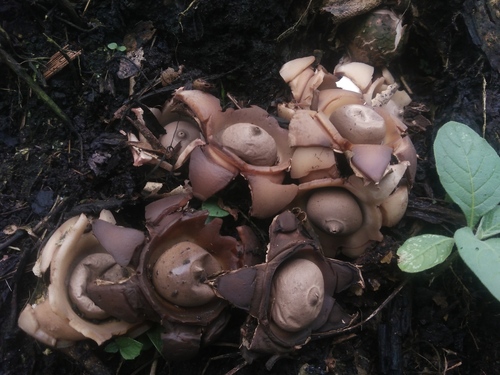
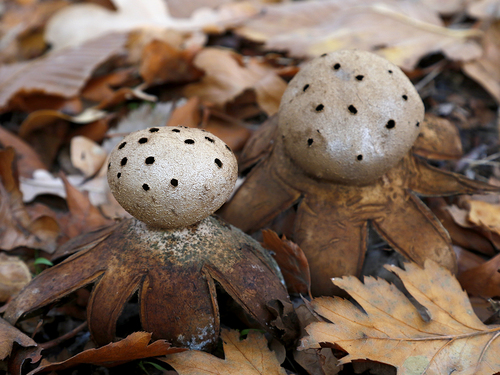
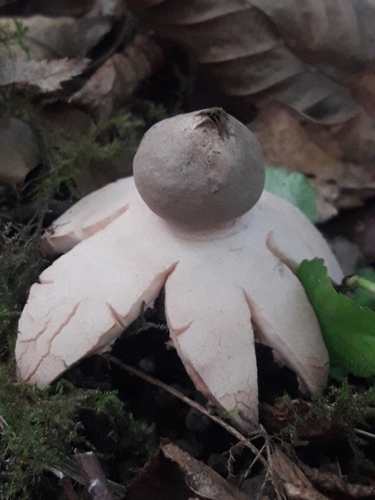
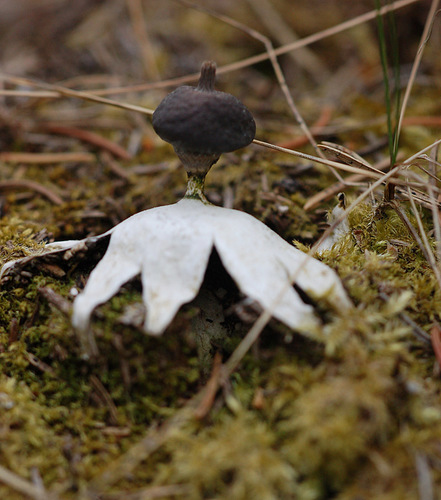
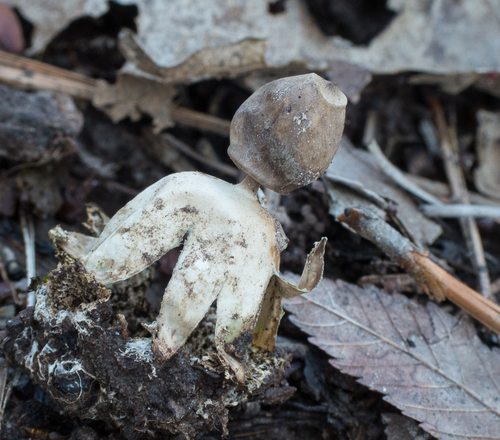
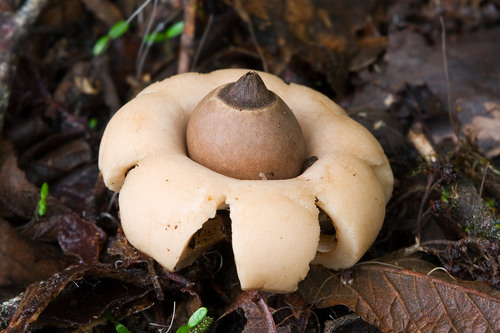
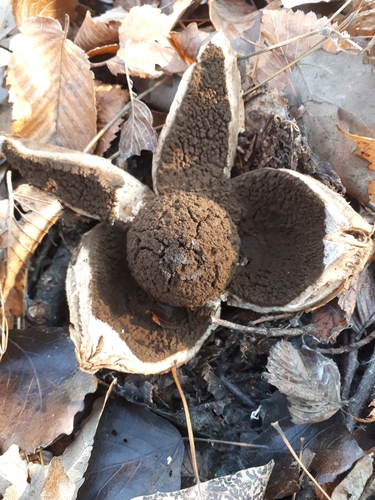
Geastrum melanocephalum (Czern.) V.J.Stanĕk produces medium to large fruiting bodies (basidiomata) that undergo dramatic morphological changes during maturation. Young fruiting bodies grow above ground (epigeous), are rounded, often onion-shaped, and reach up to 12 cm in diameter. Their outer surface is usually smooth, cracked, or scaly, is not encrusted with debris, and may have a raised knob (umbo) at the apex. A key identifying trait is that the surface of fresh specimens turns violet when damaged. As the fungus matures, its outer wall (exoperidium) splits into 4 to 8 rays, occasionally up to 13, that arch outward, often forming a characteristic collar similar to the one found in Geastrum triplex. The most distinctive feature of G. melanocephalum is its quickly disappearing (evanescent) inner spore sac (endoperidium), which bursts open during development. This leaves the spore mass (gleba) completely exposed, and reveals a prominent, stout central column (columella) with a short stalk beneath it. Basidiospores of this species are dark brown, globose to nearly spherical (subglobose), densely to coarsely warted (verrucose), and measure approximately 4–5.5 μm in diameter. The warts (verrucae) that make up the spore surface ornamentation are up to 1 μm high, with flat or somewhat rounded tips. Geastrum melanocephalum is primarily a Eurasian species, with a distribution that covers Europe and extends into Central and Eastern Asia. It has specific habitat preferences, typically growing in well-drained, calcareous, sandy, alkaline environments in dry to humid temperate zones. Documented collection locations across much of Europe include Belgium, the former Czechoslovakia (now Czech Republic and Slovakia), Denmark, Germany, Hungary, Poland, Serbia, Spain, Sweden, and Ukraine, where the species was first described. In Asia, specimens have been recorded from Kazakhstan and the desert regions of Western China. Unlike many other fungi in its order, G. melanocephalum does not form mycorrhizal relationships with trees or other plants. It grows as a saprotroph, getting nutrients by breaking down organic matter in soil. This ecological strategy matches that of most other members of the order Geastrales, which are predominantly saprotrophic. The fungus usually grows in open habitats rather than dense forests. Even though being saprotrophic often allows widespread distribution because of reduced dependence on specific plant hosts, molecular studies suggest that the distribution and dispersal of Geastrum species, including G. melanocephalum, may be limited by geographic and environmental conditions such as climate, soil properties, and vegetation types. Phylogeographic evidence shows that Swedish populations of G. melanocephalum likely originated in northern Europe, which supports the hypothesis that the species has a primarily Northern Hemisphere lineage.