About Geastrum fimbriatum Fr.
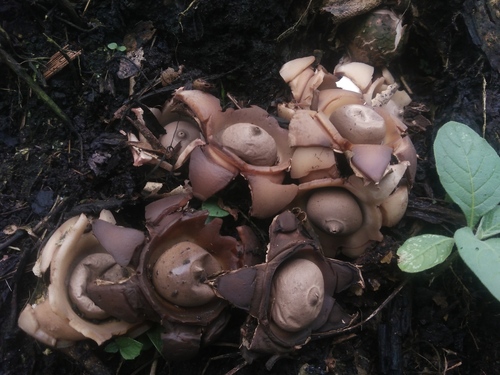
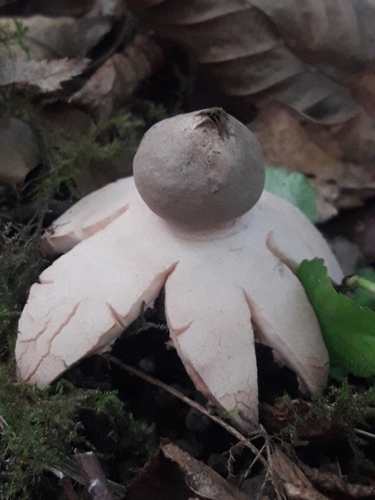
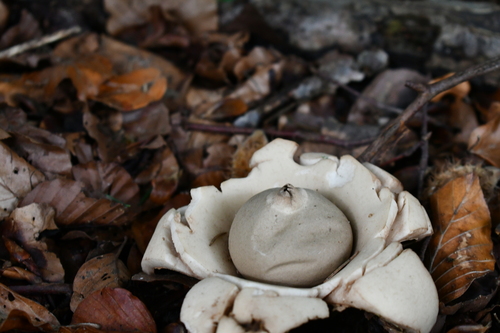
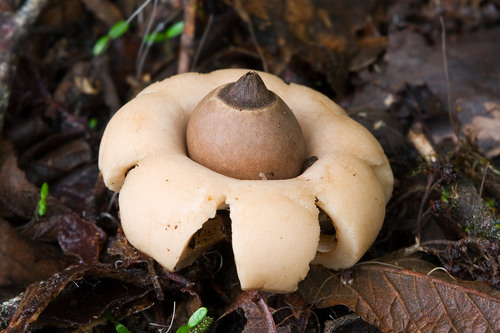
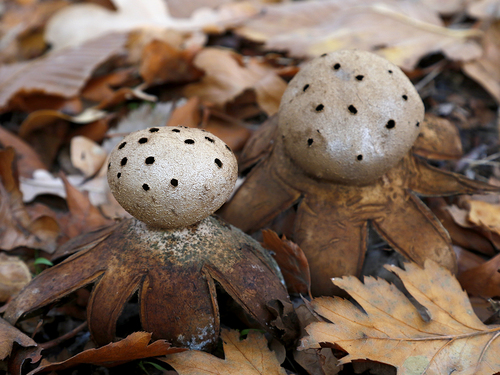
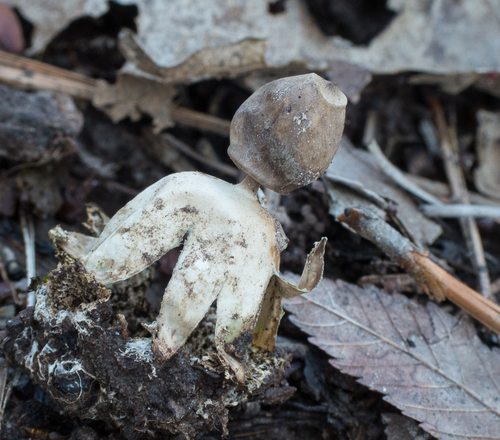
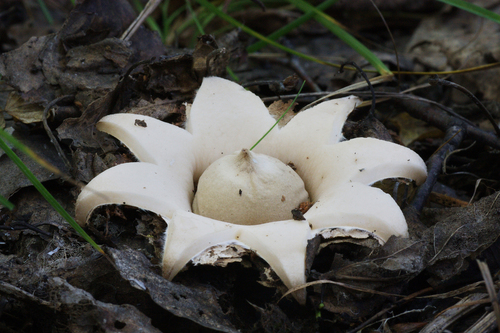
The fruit bodies of Geastrum fimbriatum begin as roughly spherical and grow underground. As the fungus matures, it pushes up through the soil, and the outer layer of the spore case, called the exoperidium, splits open to form 5 to 8 curved downward-pointing rays. Fully expanded fruit bodies reach up to 3 centimetres (1+1⁄4 inches) in diameter. Before expansion, the outer surface of the fruit body is cottony and has attached soil particles; this outer layer eventually peels off to expose a smooth, grayish-brown surface. The inner spore sac is yellowish brown and has a small conical pore with fringed edges. Unlike other similar earthstar fungi, the edges of this pore are not sharply separated from the rest of the spore sac, and do not have grooves. The fruit bodies have no distinctive taste or odor. The spores are spherical, roughened by many small points or warts, and measure between 2.4 and 4 μm. The capillitium is thick-walled, unbranched, and 4–7 μm thick. Geastrum fimbriatum is a saprobic species. Its fruit bodies grow on the ground in groups or clusters, usually near the stumps of hardwood trees. It has been found in Europe, Asia (India and Mongolia), eastern North America including Mexico, Central America (Costa Rica), and South America (Brazil). Although field guides typically list it as an inedible species, it is eaten by tribal peoples of Madhya Pradesh.