About Gazella subgutturosa (Güldenstaedt, 1780)
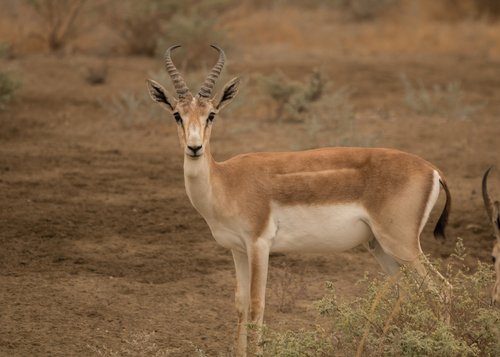
The goitered gazelle (Gazella subgutturosa), also known as the black-tailed gazelle, is a species of gazelle. It is native to Turkey, Georgia, Azerbaijan, Iran, parts of Iraq and Pakistan, Afghanistan, Tajikistan, Kyrgyzstan, Uzbekistan, Turkmenistan, Kazakhstan, northwestern China, and Mongolia. Its specific epithet, which translates to "full below the throat", refers to the enlarged neck and throat that males develop during the mating season.
Goitered gazelles live in sandy and gravel plains, as well as limestone plateaus. Large herds of this species once existed in the Near East. Around 6,000 years ago, humans captured and killed these gazelles using structures called desert kites. Rock art discovered in Jordan indicates that goitered gazelles were also slaughtered as part of ritual activities.
The goitered gazelle has a polygynous mating system, and mating typically takes place in early winter. When running, it reaches high speeds, and does not use the leaping, bounding gait that characterizes other gazelle species. Across most of its current range, the goitered gazelle undertakes seasonal migrations. In winter, herds travel 10 to 30 kilometers (6.2 to 18.6 miles) per day, while daily travel distances drop to approximately 1 to 3 kilometers (0.62 to 1.86 miles) in summer.