About Gazella bennettii (Sykes, 1831)
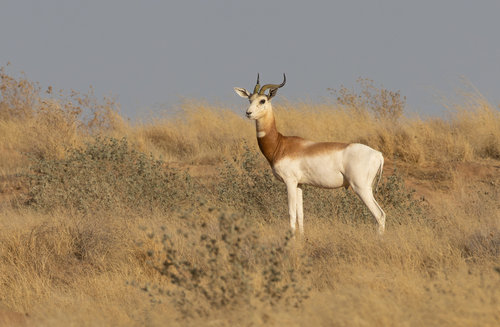
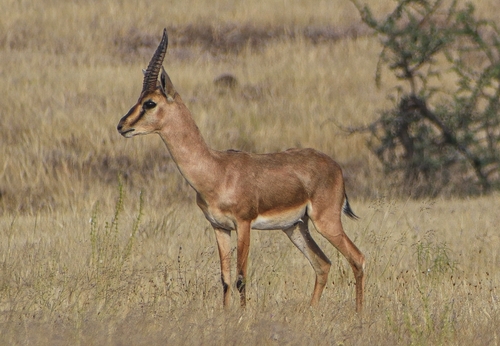
This species, commonly known as the chinkara, stands 65 cm (26 in) tall and weighs approximately 23 kg (51 lb). It has a smooth, glossy reddish-buff summer coat. In winter, the white fur on its belly and throat shows greater contrast against the rest of its coat. Dark chestnut stripes run from the corner of the eye to the muzzle on the sides of its face, and these stripes are bordered by white stripes. Both male and female chinkaras have straight, prominently ringed horns that reach over 39 cm (15 in), but females have shorter horns. Chinkaras live in arid plains and hills, deserts, dry scrub, and open forests. They are found in more than 80 protected areas across India. In Pakistan, their range extends up to elevations of 1,500 m (4,900 ft). Iran's largest chinkara population resides in Kavir National Park. In 2001, India's total chinkara population was estimated at 100,000, with 80,000 of these individuals living in the Thar Desert. Pakistan's chinkara population is scattered and has been severely reduced by hunting. Iran's chinkara population is also fragmented. Chinkaras are most likely very rare in Afghanistan. Chinkaras are swift and agile. They are nocturnal feeders, with most feeding activity taking place during the evening and night. They are browsers that feed on leaves and grasses. They are most often seen alone or in small groups of up to three individuals, which commonly include a mother and her offspring. Groups of 8 to 10 individuals are sometimes observed. Chinkaras are polygamous, and males are territorial, guarding their own territories. There are two breeding seasons each year: one at the end of the rainy season, and another at the end of spring. The gestation period for chinkaras is 5 to 5.5 months. Females usually give birth to one offspring, and occasionally to twins. Offspring stay with their mother for 12 months. Natural predators of chinkaras include Indian leopards, Bengal tigers, Asiatic lions, and dholes. In Iran, chinkara was a common prey species of the now-extirpated Asiatic cheetah. Outside of protected areas, chinkaras may be attacked by pariah dogs. Indian wolves and golden jackals are also known to hunt chinkaras.