About Gaylussacia brachycera (Michx.) Torr. & A.Gray ex A.Gray
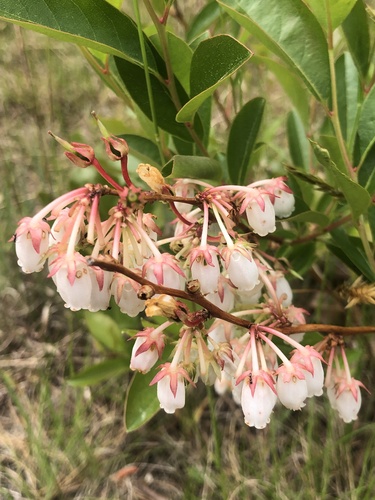
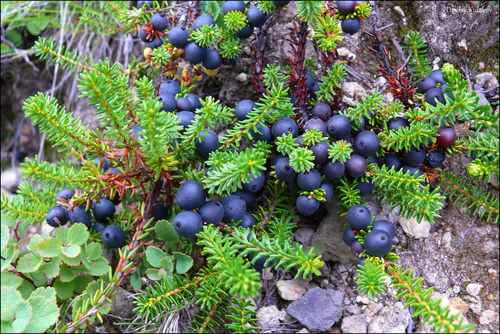
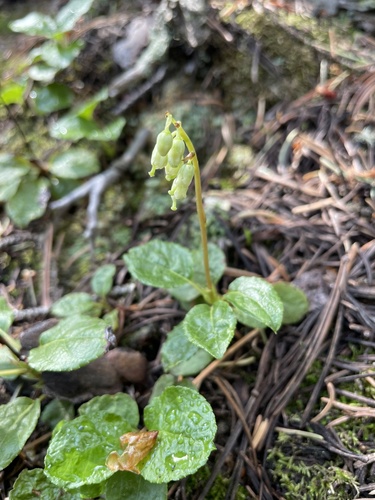
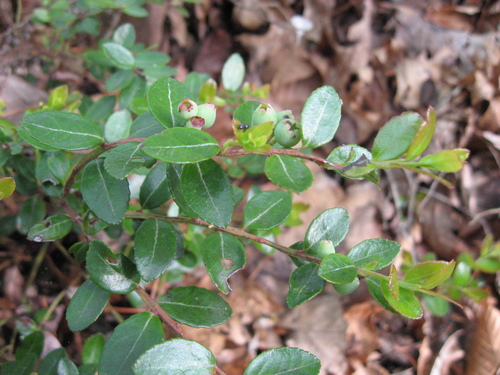
Gaylussacia brachycera, commonly known as box huckleberry, is a low-growing evergreen shrub that reaches 6 to 8 inches (150 to 200 mm) in height. It gets its common name because its leaves resemble those of boxwood. The leaves are oval-shaped, around 1 inch (2.5 cm) long, glossy, and minutely toothed; they turn red in winter, and unlike other species in the genus Gaylussacia, box huckleberry leaves do not have resin glands. Box huckleberry flowers between May and June, producing white, sometimes pink-tinged, urn-shaped flowers that grow in racemes emerging from leaf axils, just like other huckleberries. Its blue berries, which grow on short pedicels, ripen in July and August. Roughly 100 distinct locations, or stations, for box huckleberry have been documented in scientific literature. After the known West Virginia stands were lost to science by Baird's 1845 collection, his Pennsylvania colony was the only known population for some time. In 1870, William M. Canby identified box huckleberry specimens in Delaware. In 1919, Frederick V. Coville published an article in *Science* drawing attention to the species' threatened status. While researching the species for horticultural use, he only found two existing herbarium specimens: those collected by Baird and Canby (he appears to have missed Kinn's West Virginia specimen stored at the Muhlenberg Herbarium). When he surveyed the New Bloomfield site in 1918, he found that the entire colony, except for one patch separated by cultivation, was connected by roots, with no seedlings visible anywhere around the colony's margins. Coville concluded the species is self-sterile and reproduces by extending its rootstocks. After commercial nursery workers removed an entire truckload of box huckleberry from the New Bloomfield site in 1918, Coville became especially concerned with preserving the species, as this site was thought to be the only remaining extant population at the time. The site received state protection starting in 1929, and is now the Hoverter and Sholl Box Huckleberry Natural Area. In 1919, Edgar T. Wherry relocated the Delaware colony, which had been considered lost, and sent specimens to cross-pollinate with the Pennsylvania colony's specimens. This report sparked significant scientific interest in the species. Additional new colonies were found in Pennsylvania and Delaware, one in Maryland, several in Virginia, three in Tennessee between 1920 and 1930, two in Kentucky between 1927 and 1932, and many in West Virginia in 1921. When Wherry summarized these discoveries in 1932, he noted that local residents had already known about many of these colonies, and harvested the berries for food under common names including "juniper-berry", "ground-huckleberry", and "bear-huckleberry". He called on the scientific community to make greater use of this type of local knowledge when mapping plant distributions. In 2003, a new box huckleberry colony was discovered in Durham County, North Carolina, the first confirmed record of the species in that state. Per the most recent NC Natural Heritage Program List of Rare Plant Species, G. brachycera is listed as Endangered and receives protected status within North Carolina. Most documented box huckleberry stations are located within the Appalachian Mountains, ranging from central Pennsylvania in the north to eastern Tennessee in the south. However, the populations found in Maryland and Delaware grow on the Atlantic Coastal Plain, and the single North Carolina station is located in the Piedmont. Its scattered distribution suggests the species was once much more widespread across North America, but was almost entirely eradicated by glacial advances, surviving only in ice-free protected refugia. Box huckleberry prefers dry, acidic soils (including duff) and partial shade. Most wooded slope locations where it grows face north, though the New Bloomfield site faces west. At one Delaware site, a small portion of the colony extends to the wet margin of a marsh, but most of the colony grows on dry, sandy soil further upslope. Box huckleberry is self-sterile, so individual plants cannot reproduce sexually. Instead, it forms large colonies that spread via vegetative reproduction along rootstocks. One colony at Losh Run, Perry County, Pennsylvania was found to extend 6,500 feet (2,000 m) when surveyed. If this colony grew clonally from a single seed deposited along the Juniata River at a rate of 15 centimetres (5.9 in) per year, it would be roughly 13,000 years old, making it the oldest living organism in the United States and the second oldest in the world, outranked only by Lomatia tasmanica. This age estimate is now considered an overestimate based on climatic evidence: 13,000 years ago, the site was covered by a boreal forest that is thought to have been too cold for box huckleberry to survive, and the current forest community at the site only developed around 8,000 years ago. Even with this revised age, the colony would still be the oldest woody plant in North America east of the Rocky Mountains. Recent research has attempted to confirm whether all reproduction in the colony (which was heavily damaged by a 1963 forest fire and 1970s road construction) has been entirely clonal. Two distinct genotypes were found in samples from the colony, but researchers believe these arose from somatic mutation rather than sexual reproduction. The destruction of around 80% of the original colony by fire and construction means this question cannot be definitively answered today. With cooperation from the United States Department of Agriculture, ongoing efforts are working to promote G. brachycera as a landscaping groundcover. Box huckleberry is commercially available from at least one source, but it is difficult to propagate, so many nurseries do not find it profitable to carry. It is commonly marketed as 'Berried Treasure™' (the trademark symbol is not always included); while this name suggests it is a cultivated cultivar, it is simply a clone taken from a wild colony. Briggs Nursery has created a treasure chest logo and stylized title to use in its marketing for the plant. In New Bloomfield, Pennsylvania, box huckleberry is part of local New Year's celebrations: a papier-mâché replica of a huckleberry is dropped to mark the new year, instead of the traditional ball. The caterpillars of the moth Dichomeris juncidella have been recorded feeding on box huckleberry leaves. The berries are eaten by wild turkeys and ruffed grouse. Humans have harvested the berries for food in West Virginia, Kentucky, and Tennessee; Rev. Frederick W. Gray, who documented many box huckleberry colonies in West Virginia in the 1920s, first became interested in the plant after being served a "juniper" pie, where "juniper" was the local name for box huckleberry. The berries are reported to be tasteless.