About Gavicalis fasciogularis (Gould, 1854)
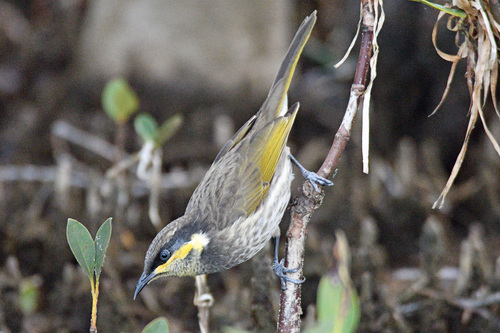
Gavicalis fasciogularis, commonly called the Mangrove Honeyeater, is a small to medium-sized nectar-eating bird. Its upper plumage is olive-brown, grading to greyish-brown on the rump and uppertail-coverts, with fine dark streaking across the top of the head and hindneck. Uppertail-coverts have olive mottling, and a broad black mask extends well down the side of the neck. A narrow yellow moustachial stripe ends in a small white tuft, which connects to a large greyish-white patch on the lower side of the neck. The tail and upperwing are olive-brown, the back is dark-grey, and only the flight feathers have yellowish-olive leading edges. The chin and throat are finely barred dark grey-brown, with a dull yellow base color. The legs are dark grey or bluish-grey, irises are dark blue-grey, and the slightly down-curved bill is dark-grey. Males weigh between 23.9g and 33.1g, while females weigh between 22g and 30g. This species is found in coastal Australia, ranging from northeast Queensland near Townsville, through the Whitsunday Islands and Moreton Bay, to northeast New South Wales. It mainly inhabits mangrove forests and woodlands that fringe coasts, bays, estuaries and islands. It is less commonly found in coastal shrubland, woodland or scrub (including stands of Eucalyptus, Banksia, Melaleuca or mixed stands of these genera) located near mangroves. Mangrove Honeyeaters regularly visit parks and gardens in some towns located adjacent to mangroves. Three Australian honeyeater species are largely restricted to mangroves. In Australian forests and coastal heathlands, it is not uncommon to find ten or more honeyeater species at a single location. Woodlands, mallee, and other semi-arid scrubs in Australia also host high numbers of honeyeater species. Within Australian forests and woodlands, most honeyeater species occupy the canopy, while some more strongly nectar-feeding species feed more often in the shrub layer. Mangrove Honeyeaters are monogamous. Among honeyeater species that have strong sexual dimorphism, polygamy or mixed mating systems may occur. Honeyeaters lay between 1 and 5 eggs, with an average clutch size of 2. The eggs are white, pinkish, or buff, marked with reddish-brown spots. For honeyeaters, the incubation period lasts 12 to 17 days, and the nesting period lasts 10 to 30 days.