About Gavia stellata (Pontoppidan, 1763)
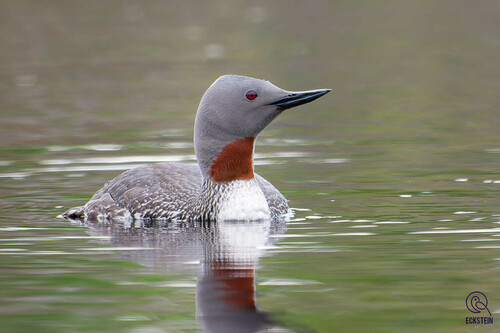
Gavia stellata, commonly called the red-throated loon, is a bird well adapted to its aquatic environment. Like other members of its genus, it has dense bones that help it submerge, legs set far back on its body that provide excellent propulsion, and a long, streamlined body. Its sharply pointed bill aids underwater streamlining; its large feet have fully webbed front three toes, and a flattened tarsus that reduces drag and lets the leg move easily through water. This species is the smallest and lightest of all the world's loon species, with a length of 53 to 69 cm (21 to 27 in), a wingspan of 91 to 120 cm (36 to 47 in), and a weight of 1 to 2.7 kg (2.2 to 6.0 lb). Like all loons, it has a long body, short neck, and legs set far back on its body. The sexes have similar appearance, though males are usually slightly larger and heavier than females. In breeding plumage, adult red-throated loons have a dark grey head and neck, with narrow black and white stripes on the back of the neck, a triangular red throat patch, white underparts, and a dark grey-brown mantle. It is the only loon species that has an all-dark back while in breeding plumage. Non-breeding plumage is more drab, with white on the chin, foreneck, and most of the face, grey on the top of the head and back of the neck, and heavy white speckling on the dark mantle. The loon's iris is carmine-red to burgundy, its legs are black on the outer half and pale on the inner half, and the webbing of its feet is pinkish-brown with darker margins. Its bill is thin, straight, sharp, and often held at an uptilted angle. One of the species' North American folk names is pegging-awl loon, a reference to its sharply pointed bill, which resembles a sailmaker's awl called a pegging awl in New England. While the bill's color changes from black in summer to pale grey in winter, the timing of this color change does not necessarily match the timing of the bird's overall plumage change. Its nostrils are narrow slits positioned near the base of the bill. Newly hatched red-throated loon chicks are covered in fine soft down feathers. They are primarily dark brown to dark grey on their upper body, slightly paler on the sides of the head and neck, throat, chest, and flanks, with pale grey lower breast and belly. Within weeks, this first down is replaced by a second, paler set of down feathers, which are later replaced by developing juvenile feathers. Juvenile plumage is similar to adult plumage, but has a few distinct features: juveniles have a darker forehead and neck, heavy speckling on the sides of the neck and throat, a browner back with less speckling, brown-tinged underparts, reddish-brown eyes, and a pale grey beak. While some young birds keep this plumage until mid-winter, many quickly become almost indistinguishable from adults, with only their paler bills marking them as juveniles. In flight, the red-throated loon has a distinctive profile. Its small feet do not extend far past the end of its body, its head and neck droop below the horizontal creating a distinctly hunchbacked shape, and its thin wings are angled backward. It has a quicker, deeper wingbeat than other loons. In terms of habitat and distribution, unlike other loons, the red-throated loon's main fishing grounds are larger lakes or the sea, rather than the lake where it breeds. Multiple nests can be located close to one another on the same breeding lake. This loon breeds primarily in Arctic regions of northern Eurasia and North America, generally north of 50°N latitude, and winters in northern coastal waters, sometimes in large groups. For example, more than 4,400 red-throated loons spend the winter in a loose group in the eastern part of the German Bight. Unlike other loons, it regularly uses very small freshwater lakes as breeding sites. Its small size makes it more versatile, but it is less able to feed on deeper prey. Compared to other loon species, the increased size and diversity of remaining loon species suggests that the benefits of larger size outweigh its limitations. In North America, the species winters regularly along both coasts, ranging as far south as the Baja California Peninsula and the Gulf of California in northwestern Mexico; it has been recorded as a vagrant in the interior Mexican state of Hidalgo. Several folk names for the species in northeastern North America, including cape race, cape brace, cape drake, cape racer, and corruptions such as scapegrace, originated from the loon's abundance around Cape Race, Newfoundland. In Europe, it breeds in Iceland, northern Scotland, northwestern Ireland (only a few pairs), Scandinavia, and northern Russia. It winters along the coast as far south as parts of Spain, and also occurs regularly along major inland waterways including the Mediterranean, Aegean, and Black Seas, as well as large rivers, lakes, and reservoirs. It has occurred as a vagrant as far south as Morocco, Tunisia, and the Gambia. In Asia, it breeds in the northern regions of Siberia, and winters along the Pacific coast as far south as China, Japan, and Taiwan. It has occurred as a vagrant in Mongolia. As for feeding, like all members of its family, the red-throated loon is primarily a fish-eater, though it sometimes feeds on molluscs, crustaceans, frogs, aquatic invertebrates, insects, fish spawn, and even plant material. It seizes rather than spears its prey, which it generally captures underwater. While it normally dives and swims using only its feet for propulsion, it may use its wings as well if it needs to turn or accelerate quickly. Its pursuit dives reach depths of 2 to 9 meters (6.6 to 29.5 feet), with an average underwater time of around one minute. Because of its fish-based diet, the red-throated loon has increased vulnerability to persistent organic pollutants and heavy metals, both of which bioaccumulate, which can create greater problems for long-lived species like this loon that sit at or near the top of the food chain. The species' main diet has also led to several British folk names, including "sprat borer" and "spratoon". For the first few days after hatching, both parents feed young red-throated loons aquatic insects and small crustaceans. After 3 to 4 days, parents switch to feeding fish small enough for the young birds to swallow whole. By four weeks of age, young red-throated loons can eat the same food, of the same size, as their parents. Young birds may continue to be fed for some time after fledging; adults have been observed feeding fish to juveniles at sea and on inland lakes in the United Kingdom, hundreds of kilometers from any breeding areas.