About Gavia immer (Brunnich, 1764)
The common loon, scientifically named Gavia immer (Brunnich, 1764). Adult common loons measure 66 to 91 cm (26 to 36 in) in length, with a wingspan of 127 to 147 cm (4 ft 2 in to 4 ft 10 in), and are slightly smaller than the similar yellow-billed loon. On average, adults are around 81 cm (32 in) long with a 136 cm (54 in) wingspan, and weigh between 2.2 to 7.6 kg (4.9 to 16.8 lb). Size varies regionally, particularly in body mass: the smallest average-sized loons come from lower-central Canada and the Great Lakes, western populations are similar or slightly larger, and loons that breed further east are noticeably significantly larger. In some populations, males can average up to nearly 27% more massive than females. For breeding loons in Maine, females averaged 4.65 kg (10.3 lb) and males 5.97 kg (13.2 lb), which is roughly the same weight as yellow-billed loons, though yellow-billed loons are larger in linear measurements, especially bill length. In Ontario, 20 females averaged 4.5 kg (9.9 lb) and 20 males averaged 5.46 kg (12.0 lb). By contrast, adults of both sexes in the Gulf of Alaska reportedly averaged 4.13 kg (9.1 lb).
Adult breeding plumage includes a broad black head and neck with a greenish, purplish, or bluish sheen. Common loons have a black bill, sometimes with a pale tip, and red eyes. A characteristic black ring encircles the neck, with two white necklaces made of 8 to 10 short streaks on the upper foreneck, and a noticeable collar of white parallel lines that forms a large oval on the side of the neck. The central lower foreneck is pure white; on the lower sides of the neck, longitudinal white lines become rows of small spots, while black lines become very narrow. The upperparts are blackish or blackish grey, and each feather bears small white spots. The upperwing is blackish with small white spots on non-primary coverts, while the underwing is paler with white coverts, except for long black shaft-streaks on the axillaries. The underparts are pure white, with some black marking on the undertail coverts and vent. Common loons have a checkered black-and-white mantle, a blackish tail, legs that are pale grey on the inner half and blackish on the outer half, and flesh-colored webbing between the toes.
Adult non-breeding plumage is brownish, with a dark neck and head marked with dark grey-brown. A white ring surrounds the eyes, and the eyelids are pale. The bill is mostly pale grey, with a dark culmen and tip, though the tip may turn whitish in early spring. The underparts, lower face, chin, and throat are whitish. The foreneck is whitish, usually forming a wedge-shaped notch in the dark sides of the neck, and may sometimes show a faint shadow of the neck ring or a pale collar. The upperparts are dark brownish grey with an unclear pattern of squares on the shoulders, and some wing coverts have white spots that are usually hidden while the bird swims. Males and females look similar, but show sexual dimorphism in size: males are larger and significantly heavier than females. The species has a heavy, evenly tapered dagger-like greyish bill, sometimes with a black tip. Bill color and angle distinguish Gavia immer from the yellow-billed loon. The common loon has a short, thick neck. It swims very low in the water, sometimes holding only its head above the surface, held horizontally. It must run across the water surface to become airborne. During flight, its head sits slightly lower than its body, with its feet trailing behind. Unlike most flying birds, which have hollow, air-filled pneumatic bones to lighten the skeleton, common loons (like other Gaviiformes and penguins) have a skeleton made of many solid bones. This adds weight, but helps the bird when diving.
Juvenile common loons often have a dark brownish-grey nape that may appear darker than the pale-edged black feathers. They have a dark grey to black head, neck, and upperparts, with a white throat, cheeks, and underparts. During the first winter, young loons do not have the fully developed bill shape of adults. By the second winter, they closely resemble breeding adults, but lack white spots on their wing coverts.
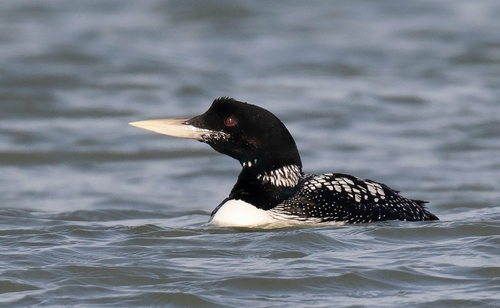
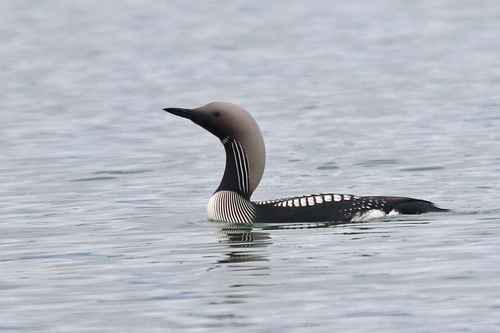
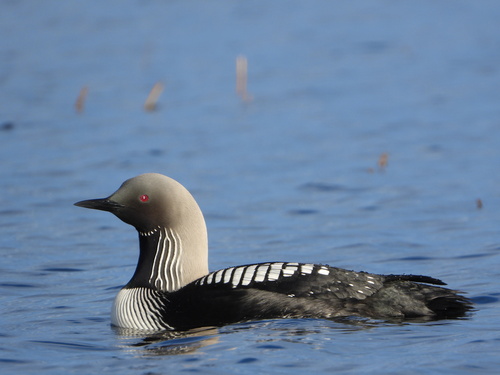
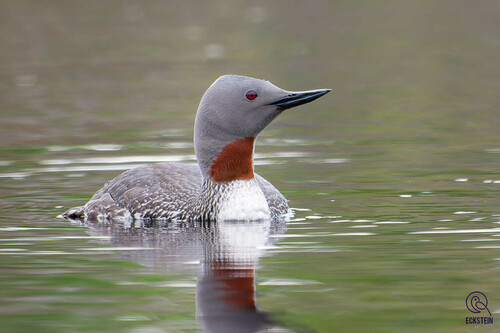
The common loon is mainly distinguished from the black-throated loon (G. arctica) and the red-throated loon (G. stellata) by its larger size. It usually has a steeper forehead and a bulging forecrown, somewhat similar to the black-throated loon. Its bill is heavier, and its back is paler than its hindneck. Separating it from the yellow-billed loon is more difficult, but in breeding plumage the common loon has more white markings on the neck, and the shoulder squares are usually smaller; in non-breeding plumage it has darker neck sides that create a sharper contrast with pale areas, plus different bill coloration.
Common loons are primarily a Nearctic species, breeding from 48° N to the Arctic Circle, locally as far south as 40° N and as far north as 78° N. During the spring and summer breeding season, most common loons live on lakes and other waterways in the northern United States and Canada, as well as in southern Greenland, Iceland, Svalbard, Jan Mayen, and Bear Island (Norway). Their breeding range extends west to Alaska, and very rarely east to Scotland. Their summer habitat ranges from wooded lakes to tundra ponds. The lakes they use must be large enough for flight take-off, and support a large population of small fish. Breeding loons have more success raising young on deep lakes with warm surface waters, relatively low biological productivity, and low turbidity, which makes their fish prey easier to spot. To protect themselves from predators, common loons prefer lakes with islands and coves. They are rare visitors to the Arctic coast, and are known for high breeding site fidelity. Some common loons stay in Iceland year-round, but most migrate.
In North America, common loons winter mainly along the north Atlantic and north-east Pacific coasts, with many stopping on the Great Lakes during migration. They migrate during the day, starting around two hours after sunrise, and fly at altitudes of 1500 to 2700 m above sea level, above the convective, turbulent air layer. In winter, they can be found on North American coasts as far south as Baja California, Sonora, northern Sinaloa, southern Texas, and rarely northern Tamaulipas. In the east, several thousand common loons winter along western European coasts, and probably originate from Iceland, Greenland, and Canada. Their range extends into northwestern Europe from Finland to Portugal, southern and northwestern Spain (Galicia and Asturias), the western Mediterranean off Catalonia, and off the coast of Morocco in Africa. Only a few hundred travel as far south as Iberia. While wintering site fidelity is not well studied, adult loons have been observed returning to the same wintering locations annually, including Morro Bay in the Pacific Ocean, Barataria Bay in the Gulf of Mexico, Maryland and Massachusetts coastal areas in the Atlantic Ocean, and the reservoir Lake Pateros. They usually winter along coasts and on inland lakes, bays, inlets, and streams, and migrating birds travel to the nearest body of water that will not freeze over in winter: western Canadian loons go to the Pacific, Great Lakes loons go to the Gulf of Mexico region, eastern Canadian loons go to the Atlantic, and some loons use large inland lakes and reservoirs. They appear in most inland waters of the United States. Some of the highest concentrations of wintering common loons are found on the South Carolina coast, the Gulf coast adjacent to the Florida panhandle, and the Atlantic seaboard from Massachusetts to Maine. Occasional vagrant common loons have been recorded inland in Mexico, in San Luis Potosí and Coahuila, as well as further south in Chiapas and Oaxaca. They are accidental visitors to northern Japan, the Commander Islands in the northwestern Pacific, and Cuba in the West Indies.
As breeders, common loons show a strong tendency to settle on a lake that resembles their natal lake, a behavior called natal habitat imprinting. This preference is based on two lake attributes: size and pH. This behavior is considered puzzling, because the preference is just as strong in loons hatched on small, acidic lakes as it is in those from large, neutral pH lakes. As a result, loons from small acidic lakes actively prefer lakes that are known to cause higher chick mortality and lower breeding success.
Over the last century, the common loon's breeding range has shifted northward; a century ago, the species bred as far south as Iowa. The species is negatively affected by acid rain, pollution, lead poisoning from fishing sinkers (especially sinkers around the size of the grit stones loons ingest), and mercury contamination from industrial waste. Heavy metals such as mercury can be partially removed through biological processes like excretion or deposition in feathers, but their adverse effects are magnified as the toxic elements concentrate in organs such as the liver. Egg shells may also contain metal contaminants, which leads to low reproductive output. High levels of heavy metals are linked to poor body condition in loons, and males are affected more because they eat larger fish.
The common loon's breeding range has also declined due to hunting, predation, and water-level fluctuations or flooding. Some environmentalists work to improve nesting success by reducing the impacts of these threats, specifically terrestrial predation and water-level fluctuations, by placing rafts in the loons' breeding territories. Additionally, artificial floating nesting platforms have been placed on some lakes for common loons to reduce the impact of changing water levels caused by dams and other human activities. Common loons abandon lakes that no longer provide suitable nesting habitat due to shoreline development. The species is threatened by personal water-craft and powerboats, which may drown newly hatched chicks, wash eggs away, or swamp nests. It is still considered an "injured" species in Alaska as a result of the Exxon Valdez oil spill. In a 2003 survey of dead common loons in New England, lead poisoning from fishing weights caused around half of all recorded deaths, and other human factors directly caused the death of 52% of the 522 loons observed in the survey.