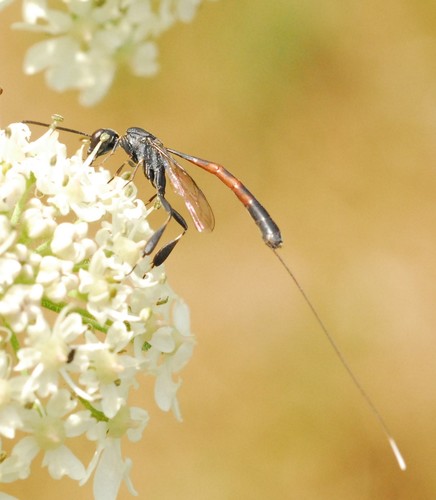
About Gasteruption jaculator (Linnaeus, 1758)
The head and thorax of Gasteruption jaculator are entirely black. The head is strongly rounded, and the thorax has an elongated long neck (propleura) that separates the head from the rest of the body. The abdomen is also strongly elongated, wider at the posterior end, and is attached to the upper chest (propodeum). The abdomen is black, marked with reddish-orange rings. The tibiae of the hind legs have a club-like shape. Females typically have a very long ovipositor with a white tip. When at rest, these wasps slowly and rhythmically raise and lower their abdomen. This species occurs mainly in Austria, Belgium, Great Britain, the Czech Republic, Finland, France, Germany, Greece, Hungary, Italy, Poland, Romania, Russia, Slovakia, Spain, Sweden, and Switzerland, as well as in the eastern Palearctic realm and the Near East. Gasteruption jaculator has been observed visiting various flowers, or hovering around the nests of solitary bees and wasps, in gardens and meadows. It is commonly encountered from May to September. Gasteruption jaculator is a parasitic wasp. Females use their long ovipositor to lay eggs on the bodies of solitary bee or solitary wasp larvae. After hatching, Gasteruption jaculator larvae eat the host grub, along with the host's stored pollen and nectar supplies. Adult wasps reach a total length of 10–17 millimetres (0.39–0.67 in), and are most commonly seen from May through September, when they feed on Apiaceae species.

