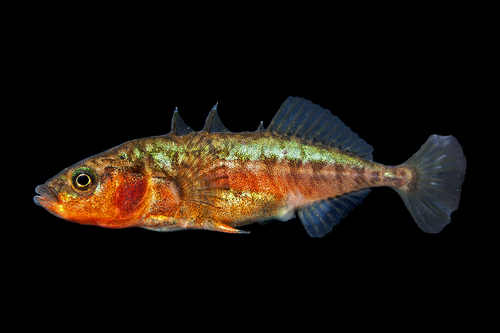
About Gasterosteus aculeatus Linnaeus, 1758
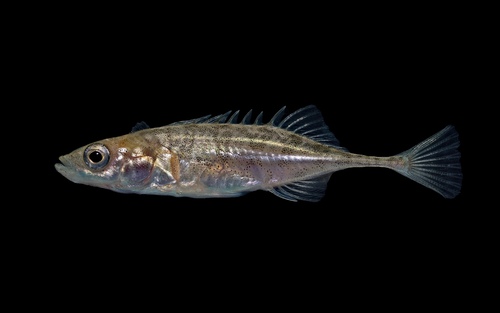
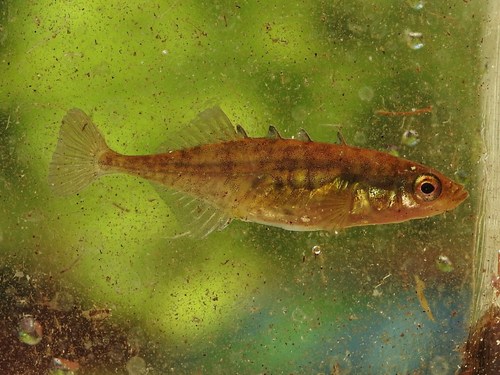
Gasterosteus aculeatus Linnaeus, 1758, commonly known as the three-spined stickleback, occasionally reaches 8 cm (3.1 in) in length, but mature individuals most commonly grow to 3–4 cm (1.2–1.6 in). Its body is laterally compressed, with a slender tail base. The caudal fin has 12 rays, and the dorsal fin has 10–14 rays; three spines sit in front of the dorsal fin, which give the species its name, though some individuals have only two or four spines. The third spine, the closest to the dorsal fin, is much shorter than the other two, and a thin membrane connects the back of each spine to the body. The anal fin has 8 to 11 rays, and pelvic fins each consist of just one spine and one ray. All spines can be locked in an erect position, making the fish extremely hard for predators to swallow. The pectoral fins are large, with 10 rays. The body has no scales, and is instead protected by bony plates on the back, flanks, and belly. Only one ventral plate is present, but the number of flank plates varies widely across the species' distribution range and across habitat types; numbers are normally higher in marine populations, and some freshwater populations lack lateral plates entirely. Dorsal coloration varies, but most often is a drab olive or silvery green, sometimes with brown mottling. The flanks and belly are silvery. During the breeding season, males develop blue eyes and bright red coloration on the lower head, throat, and anterior belly; breeding females may develop a slight pink tint on the throat and belly. A small number of populations have breeding males that are entirely black or entirely white.
Three subspecies are recognized by the IUCN. G. a. aculeatus occurs across most of the species' full range, and is the subspecies most strictly referred to as the three-spined stickleback; its common names in Britain are tiddler, and sometimes tittlebat. G. a. williamsoni, the unarmored threespine stickleback, is found only in North America, with a recognized range in southern California, though there are isolated reports of it occurring in British Columbia and Mexico. G. a. santaeannae, the Santa Ana stickleback, is also restricted to North America. These three subspecies are just three examples of the enormous range of morphological variation present within the three-spined stickleback. Hybrids between some of these morphs have foraging disadvantages, which is a form of reinforcement during speciation, and this serves as evidence for speciation by reinforcement.
Overall, these morphs fall into two broad categories: anadromous and freshwater forms. The anadromous form spends most of its adult life feeding on plankton and fish in the sea, and returns to freshwater to breed. Adult anadromous fish are typically 6 to 10 cm long, have 30 to 40 lateral armor plates along their sides, and have long dorsal and pelvic spines. Anadromous three-spined sticklebacks are morphologically similar across the entire Northern Hemisphere, with individuals from the Baltic, Atlantic, and Pacific all closely resembling one another.
Three-spined stickleback populations also live in freshwater lakes and streams. These populations most likely formed when anadromous fish began spending their entire lifecycle in fresh water, and evolved to live there year-round. Freshwater populations are extremely morphologically diverse, to the point that many observers and some taxonomists would describe a new three-spined stickleback subspecies in almost every Northern Hemisphere lake. One consistent difference between freshwater populations and their anadromous ancestors is the amount of body armor: most freshwater fish have between zero and 12 lateral armor plates, and shorter dorsal and pelvic spines. Large morphological differences also exist between populations in different lakes. One major axis of variation separates populations in deep, steep-sided lakes from those in small, shallow lakes. Fish in deep lakes typically feed on plankton in surface waters, and often have large eyes, short slim bodies, and upturned jaws; some researchers call this the limnetic form. Fish from shallow lakes feed mainly on the lake bed, and are often long and heavy-bodied with relatively horizontal jaws and small eyes; these populations are called the benthic form.
Since each watershed was probably colonized separately by anadromous sticklebacks, it is widely believed that morphologically similar populations in different watersheds or on different continents evolved independently. A unique population lives in the meromictic Pink Lake in Gatineau Park, Quebec. Populations have been observed adapting rapidly to new conditions, such as in Lake Union, where sticklebacks have lost and regained armor plates in response to human-caused pollution in the surrounding watershed.
One feature of this morphological variation is that multiple lakes contain both limnetic and benthic types that do not interbreed with each other. Evolutionary biologists often use the biological species concept, which defines species as populations that do not interbreed with each other, meaning the benthic and limnetic forms within each lake would count as separate species. These species pairs are a clear example of how adaptation to different environments (in this case, feeding in surface waters or on the lake bed) can generate new species, a process called ecological speciation. This type of species pair is found in British Columbia, occurring only in lakes on islands that contain only three-spined sticklebacks and cutthroat trout. The species pair in Hadley Lake on Lasqueti Island was destroyed in the mid-1980s after a predatory catfish was introduced, and the pair in Enos Lake on Vancouver Island has started to interbreed and is no longer two distinct species. The two remaining pairs, located in Paxton Lake and Priest Lake on Texada Island, are listed as Endangered under the Canadian Species at Risk Act.
Other species pairs, consisting of a well-armored marine form and a smaller, unarmored freshwater form, are studied in ponds and lakes in south-central Alaska that were once marine habitats uplifted during the 1964 Alaska earthquake. The evolutionary dynamics of these species pairs serve as a model for speciation processes that have taken place in less than 20 years in at least one lake. In 1982, a chemical eradication program at Loberg Lake, Alaska, carried out to create habitat for trout and salmon, killed the resident freshwater stickleback population. Oceanic sticklebacks from nearby Cook Inlet recolonized the lake. Starting in 1990, over just 12 years, the frequency of the oceanic form dropped steadily from 100% to 11%, while a variety with fewer plates increased to make up 75% of the population, with various intermediate forms making up the remaining small fraction. This rapid evolution is thought to be possible through genetic variations that give competitive survival advantages in fresh water when conditions shift rapidly from salt to fresh water, but the exact molecular basis of this evolution remains unknown.
While the three-spined stickleback is found across many locations around Northern Hemisphere coasts, and is thus classified as Least Concern by the IUCN, the unique evolutionary history of many freshwater populations means further legal protection may be needed.
The three-spined stickleback occurs only in the Northern Hemisphere, where it usually lives in coastal waters or freshwater bodies. It can survive in fresh, brackish, or salt water, and prefers slow-flowing water with areas of emerging vegetation. It can be found in ditches, ponds, lakes, backwaters, quiet rivers, sheltered bays, marshes, and harbours. In North America, it ranges along the East Coast from Chesapeake Bay to the southern half of Baffin Island and the western shore of Hudson Bay, and along the West Coast from southern California to the western shore of Alaska and the Aleutian Islands. It occurs throughout Europe between 35 and 70°N. In Asia, its distribution stretches from Japan and the Korean peninsula to the Bering Straits. Its distribution is almost circumpolar, but it is absent from the north coast of Siberia, the north coast of Alaska, and the Arctic islands of Canada.
Sexual maturation in three-spined sticklebacks depends on environmental temperature and photoperiod: longer, warmer days stimulate brighter coloration in males and egg development in females. Starting in late April, males and females move from deeper water to shallow areas. Each male defends a territory where he builds a nest on the bottom. He begins by digging a small pit, then fills it with plant material (often filamentous algae), sand, and debris, which he glues together with spiggin, a proteinaceous substance secreted from his kidneys. The name spiggin comes from spigg, the Swedish name for the three-spined stickleback. Next, he creates a tunnel through the roughly spherical nest by swimming vigorously through it. Nest building typically takes 5–6 hours, though it may be spread over several days.
After nest building is complete, the male courts gravid females that pass by with a zigzag dance; in some populations, the male leads the female to the nest instead of performing the zigzag dance. He approaches a female by swimming very short distances left and right, then swims back to the nest the same way. If the female follows, the male often pokes his head inside the nest, and may swim through the tunnel. The female then swims through the tunnel, where she deposits 40–300 eggs. The male follows to fertilize the eggs, then chases the female away. For the entire development period of the eggs, the male chases away other males and non-gravid females, but may court other gravid females, and more than one batch of eggs can be deposited in the same nest.
Niko Tinbergen described this sequence of territorial courtship and mating behaviours in detail in a landmark early ethology study. Tinbergen found that the red throat color of territorial males acts as a simple sign stimulus, triggering aggression in other males and attracting females. Females may also use the red coloration to assess male quality. Red coloration is produced from carotenoids obtained from the fish's diet; since carotenoids cannot be synthesized de novo, color intensity indicates male quality (ability to find food), and higher-quality males have more intense coloration. Males with fewer parasites also tend to have brighter red colors, and many studies show females prefer males with brighter red coloration. However, the response to red is not universal across the entire species, with black-throated populations often found in peat-stained waters.
The male cares for developing eggs by fanning them. He positions himself aligned with the entrance to the nest tunnel and swims on the spot; the movement of his pectoral fins creates a current of water through the nest, bringing well-oxygenated fresh water to the eggs. He does this both day and night. Fanning intensity increases until the eggs are ready to hatch, which takes 7–8 days at 18–20 °C (64–68 °F). Fanning also increases when water is poorly oxygenated. Towards the end of egg development, the male often makes holes in the roof and near the rim of the nest, likely to improve ventilation during fanning when eggs have higher metabolic activity. Once the young hatch, the male keeps them grouped together for a few days, sucking any stray hatchlings into his mouth and spitting them back into the nest. After this period, the young disperse, and the male either abandons the nest or repairs it for another breeding cycle.
In Nova Scotia, one three-spined stickleback population differs from the standard parental care pattern. Unlike other sticklebacks that nest on the substrate, Nova Scotian males build nests in mats of filamentous algae. Almost immediately after fertilization, the males disperse the eggs from the nest and begin soliciting more females for eggs, so this population has lost parental care. These males have reduced dorsal pigmentation, giving them a pearlescent white appearance, leading to the name "white sticklebacks". It is unknown whether they are a distinct species, or just a morph of the common Atlantic stickleback.
Because the three-spined stickleback's breeding cycle depends on light and temperature, breeding can be manipulated in laboratory settings. For example, under the right conditions sticklebacks can be stimulated to breed twice per calendar year instead of once, which is useful for multi-generational genetic and behavioural studies. Infection with the cestode parasite Schistocephalus solidus can reduce egg mass or cause complete absence of eggs in female three-spined sticklebacks.