About Gasteracantha versicolor (Walckenaer, 1841)
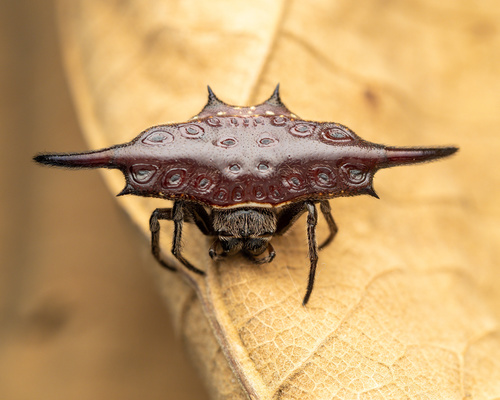
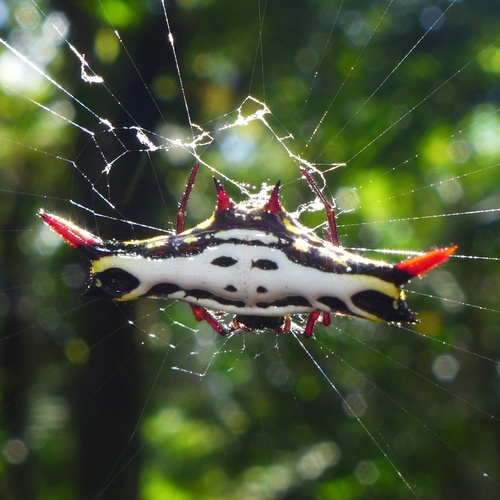
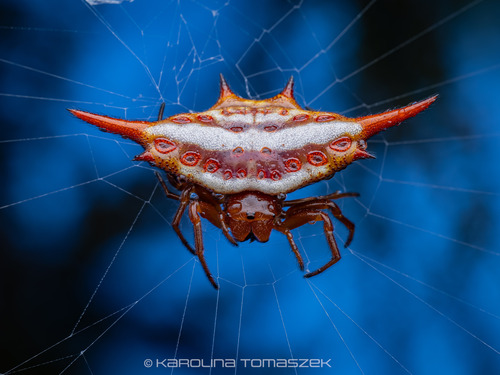
Female Gasteracantha versicolor measure 8 to 10 mm in body length, and have a large, glossy, brightly coloured abdomen that matches the typical appearance of other species in the Gasteracantha genus. Their abdomen is hardened (sclerotised), extends over the cephalothorax, and has six peripheral spines; in this species, the lateral pair of spines are medium to long and slightly recurved. Males are much smaller, less colourful, and do not have these thorny abdominal projections. The webs built by this species have densely spaced radii and an open hub, and can be positioned anywhere from near ground level to several meters above ground. Like most spiders, the venom of Gasteracantha versicolor is not known to be dangerous to humans. Gasteracantha versicolor is widespread across Africa, ranging from Uganda to South Africa, and including Madagascar. In South Africa, the species occurs across a very large geographical area in six provinces, at altitudes from 7 to 1,710 m above sea level. The South African provinces where it is found are Eastern Cape, Gauteng, KwaZulu-Natal, Limpopo, Mpumalanga, and Western Cape. Documented notable localities include East London, Coffee Bay, Port Elizabeth, Durban, Kruger National Park, Nelspruit, and Table Mountain National Park. Gasteracantha versicolor is an orb-web spider that is commonly found in warmer tropical regions. These spiders usually build their orb-webs high between trees or tall shrubs, above the observer's eye level. The bridge line of the web is often longer than the orb section of the web, which creates the impression that the spider is floating in space. Webs are sometimes decorated with tufts of silk. The spiders are active during the day and do not remove their webs. This species has been sampled in the Fynbos, Forest, Grassland, and Savanna biomes, and has also been recorded living in citrus orchards.