About Garrya wrightii Torr.
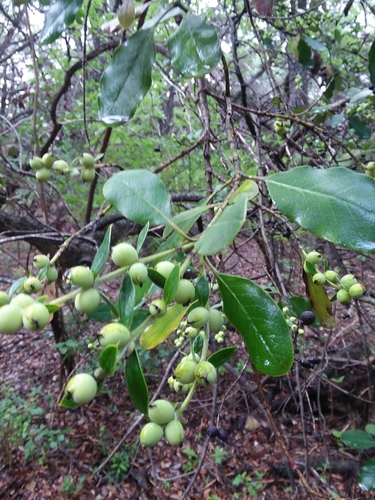
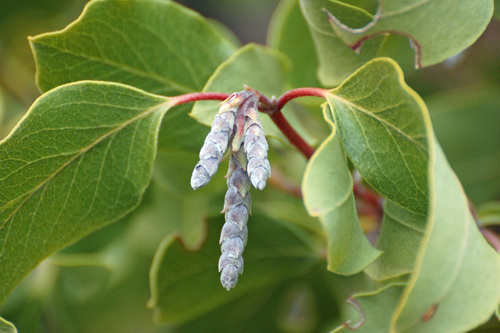
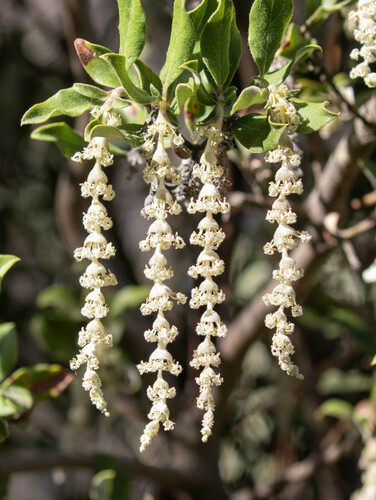
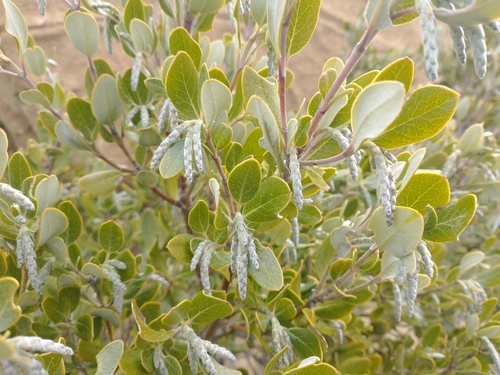
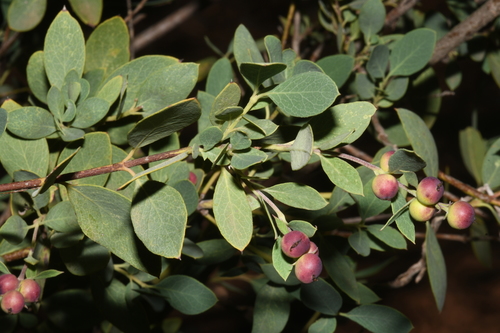
Garrya wrightii Torr. is a slow-growing shrub that reaches heights of 3.7 to 11.0 meters (12 to 36 feet). Its branches are square in cross-section, and it bears thick, tough leaves. This species is dioecious, meaning male and female reproductive structures grow on separate individual plants. Both types of flowers are produced in catkin-like spikes and are green in color. The fruit is a rounded purple berry less than one centimeter wide, holding one or two seeds. Birds that eat the berries disperse the plant's seeds.
This plant is native to northern Mexico and the southwestern United States, specifically Arizona, New Mexico, and Texas. It grows on rocky slopes and in cliff crevices, at elevations between 1,500 and 2,400 meters (5,000 to 8,000 feet).
Garrya wrightii occurs in chaparral, pinyon-juniper woodlands, and Madrean pine-oak woodlands. It is rarely a dominant species, but it appears in many types of plant communities. It often grows alongside multiple oak species, including Emory oak (Quercus emoryi), gray oak (Quercus grisea), and Coahuila scrub oak (Quercus intricata). Other common associated plants in its habitat are birchleaf mountain-mahogany (Cercocarpus betuloides), true mountain-mahogany (Cercocarpus montanus), skunkbush sumac (Rhus trilobata), desert ceanothus (Ceanothus greggii), pointleaf manzanita (Arctostaphylos pungens), Pringle manzanita (Arctostaphylos pringlei), yellowleaf silktassel (Garrya flavescens), and hollyleaf buckthorn (Rhamnus crocea). It is adapted to habitats that are prone to wildfire, and resprouts from the base after its above-ground growth is killed by fire.
Small amounts of rubber can be produced from Garrya wrightii. Livestock occasionally feed on this plant, with goats being particularly fond of it. Cattle generally avoid the plant due to its bitter taste. Many wild ungulates, including mule deer, bighorn sheep, and elk, browse the shrub.
Garrya wrightii is cultivated as an ornamental plant. It is planted as a shrub or small multi-trunked tree in gardens, and is used in drought-tolerant gardens, wildlife gardens, and natural landscaping. It is also used for erosion control and habitat restoration projects.