About Garrulax treacheri (Sharpe, 1879)
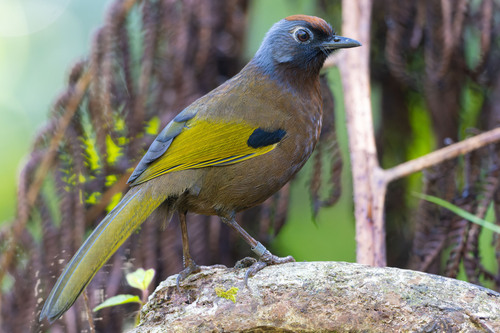
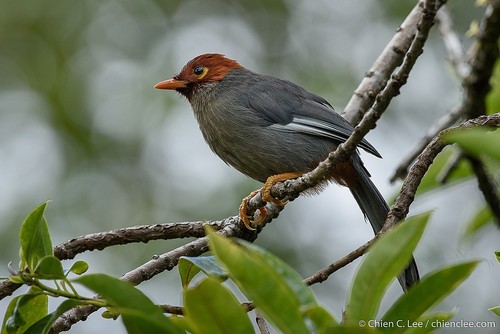
The chestnut-hooded laughingthrush, with the scientific name Garrulax treacheri, measures 22–24 cm (8.7–9.4 in) in length, and adult males and females look very similar. For the nominate subspecies, the chin, lores (the area between the eyes and nostrils), supercilium (the stripe above the eye), feathers around the nostrils, and the area surrounding the base of the bill are chestnut brown. The forehead, the front portion of the crown (the top of the head), and the area extending from the eyes down to the chin are darker, with some greyish-white feathering present on the crown. The throat, breast, and upper belly are dull yellowish-brown with a greyish tinge and marked with dull yellowish-brown streaking. The flanks are a purer grey, while the lower belly, thighs, and vent are reddish-brown. The side of the neck and upperparts are slaty-grey with a faint yellowish-brown tinge, and there is a long white patch on the primaries. The tail is darker grey and has a blackish tip. The iris ranges from red to reddish-brown, with a yellow half eye-ring located behind and below the eye. The bill is dull orange to yellowish-brown, and the legs are yellowish. Juvenile individuals are duller in overall colouration than adults. The subspecies P. t. damnatus has a duller breast with less streaking than the nominate, while P. t. griswoldi has more intensely coloured chestnut on the vent. This species can be distinguished from the chestnut-capped laughingthrush by the feathering on its nostrils, its yellow (rather than white) eye-ring that is only found behind and below the eye, its chestnut brown chin, greyer upperparts, paler underparts, and greyer feathers on the crown. An undescribed subspecies from western and southeastern Borneo differs from the three already recognized subspecies in the colour of its underparts, which are peachy-buff instead of buff-grey, the presence of white markings below the eye, and the lack of streaking on the chest. The chestnut-hooded laughingthrush is endemic to the island of Borneo. On the island, it occurs in the north-central mountain ranges stretching from Mount Kinabalu to Barito Ulu, as well as in the Meratus Mountains in the island’s southeast. It inhabits evergreen montane forest, hill forest, forest edges, secondary forest, disturbed vegetation, and cultivated areas including short growth in abandoned rice fields. It most commonly occurs at elevations between 600–2,800 m (2,000–9,200 ft), but can occasionally be found as low as 200 m (660 ft) and as high as 3,350 m (10,990 ft). In terms of behaviour and ecology, the chestnut-hooded laughingthrush forages in small groups of 4–5 individuals. It frequently joins mixed-species foraging flocks that may contain Sunda cuckooshrikes, Sunda laughingthrushes, Whitehead's broadbills, and Whitehead's trogons. These mixed flocks can also include Tupaia treeshrews and Dremomys squirrels foraging on the ground, and Sundasciurus squirrels foraging in the canopy.