About Garrulax chinensis (Scopoli, 1786)
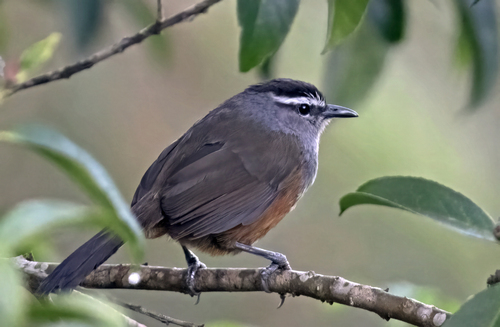
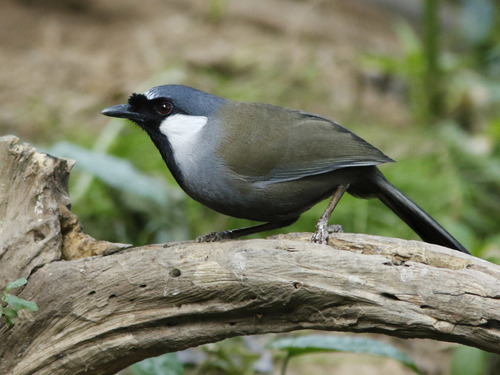
The black-throated laughingthrush, scientifically known as either Garrulax chinensis or Pterorhinus chinensis, is a bird species belonging to the family Leiothrichidae. Its native distribution covers Cambodia, China, Laos, Myanmar, Thailand, and Vietnam, with most of its native range spanning Indochina and southern China, including southern Hainan Island. Within Indochina, it can be found in eastern Myanmar, Thailand, most of Vietnam and Laos, and eastern Cambodia. A single individual was sighted on Mount Saramati in western Myanmar, which lies outside of its typical native range. The species is not present in southern and central Thailand. Its natural native habitats are subtropical or tropical moist lowland forest and subtropical or tropical moist montane forest, and it generally occurs at submontane to montane elevations. It occupies a range of woodland habitats, with a preference for broadleaf evergreen forest, mixed deciduous forest, and secondary forest, and can be found at elevations up to 1,525 m (5,000 ft). In Indochina, it is most abundant in lower montane forest, but has also been documented in bamboo thickets, scrubland, and grassy areas. The endemic Hainan subspecies is mostly limited to Hainan Bawangling National Nature Reserve at 400 m (1,310 ft) elevation, though it is occasionally observed in forested areas up to 1,200 m (3,940 ft) elevation. This species has been introduced to many locations outside its native range. It was introduced twice to the Hawaiian island of Kauaʻi, in 1931 and 1941, but the local population was apparently extirpated by 1967. The population of black-throated laughingthrushes in Hong Kong is believed to be descended from released cagebirds. The species has also been introduced to Taiwan, where its population is currently growing. In Thailand, a feral population at the Bang Phra Non-hunting Area in Chonburi most likely originates from escapees from a nearby wildlife breeding station. Sightings of the species in Bangkok are almost certainly long-lived escaped individuals, and there are no records of the species breeding within the city. It has additionally been introduced to Singapore. In Hainan, there are recorded sightings of introduced individuals of the mainland subspecies. In introduced ranges, the species occupies habitats matching local conditions: in Hong Kong it lives in urban parks, while in Taiwan it occurs in lowland and hill forests.