About Ganoderma oregonense Murrill
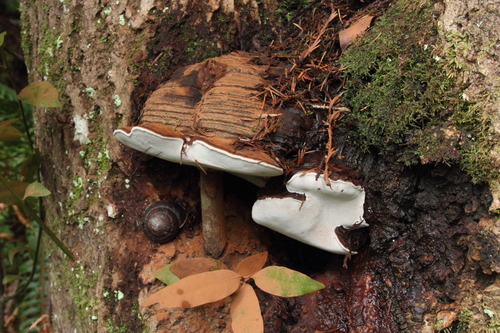
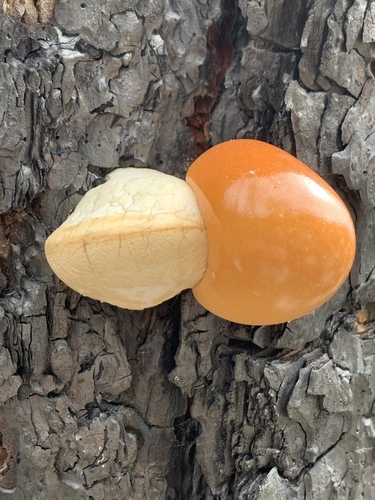
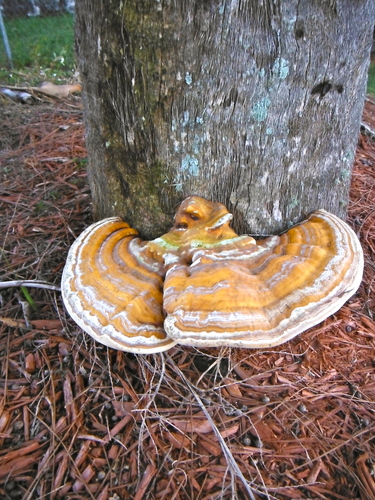
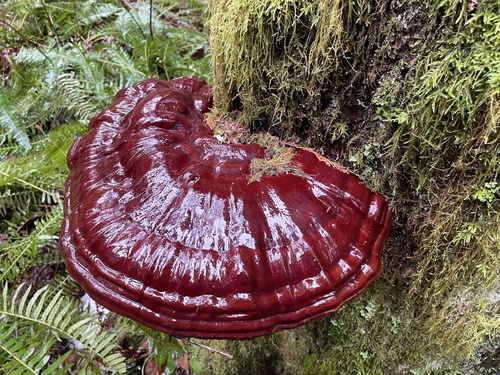
Commonly called the western varnished conk, Ganoderma oregonense Murrill has a shiny brown-red-orange upper surface that is sometimes cream-colored, often forming a color gradient, with white or cream-colored pores. Its shape can be kidney-shaped, fan-shaped, hoof-shaped, plate-shaped, or a stack of plates wedged into the side of a log. It fruits annually rather than perennially, and usually produces fruiting bodies in the fall. Fruiting bodies can grow 10 to 50 centimetres (4 to 19+1⁄2 inches) wide, and sometimes have a stem that is 2.5 to 10 cm (1 to 4 inches) long and 0.5 to 4 cm (1⁄4 to 1+1⁄2 inches) thick. This fungus is distributed in northwestern coastal North America, including California, Oregon, Washington, British Columbia, Yukon, and Alaska. It can be found year-round, but is freshest between July and November. Trees infected with G. oregonense develop spongy, soft inner wood. It prefers dead red fir, but will also grow on dead or living Douglas fir, spruce, hemlock, and pine. When found on living trees, it typically colonizes areas after tree wounds, such as bear claw marks. According to Paul Stamets, this fungus is edible. This is unusual for species in the Ganoderma genus, which are usually too tough to eat. Reishi mushrooms like this are often dried, powdered, and consumed as mushroom tea.