About Gangara thyrsis (Fabricius, 1775)
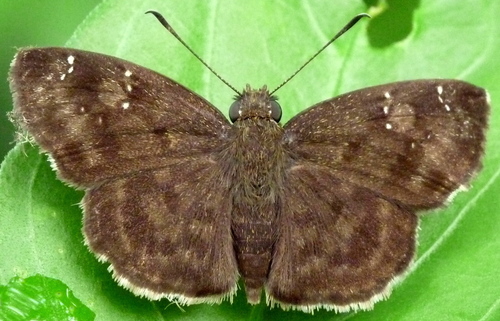
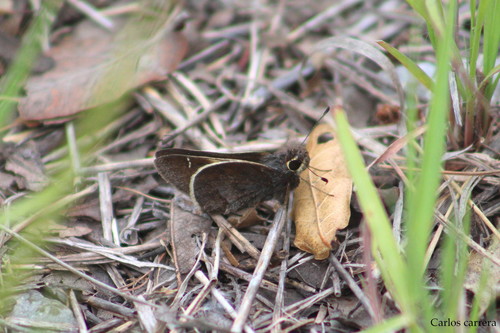
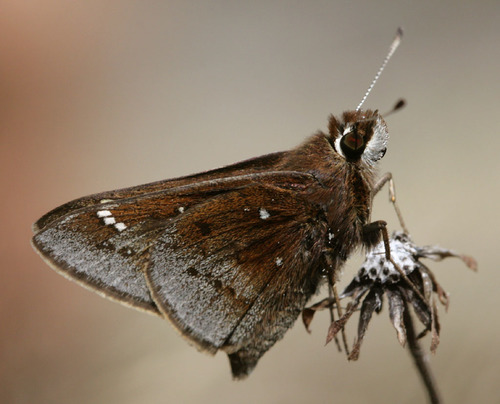
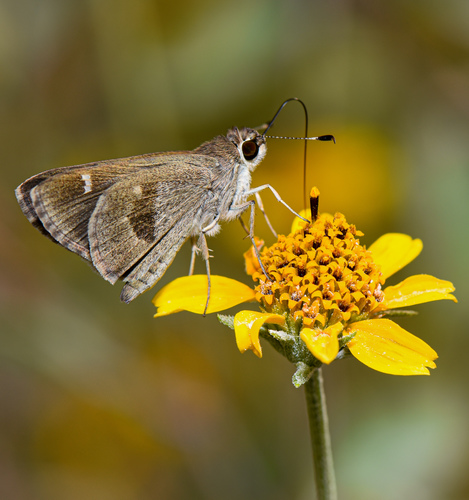
Both male and female individuals of this species have dark chocolate brown wings. The forewing has bright yellow, semi-transparent, square-shaped spots arranged in a triangular pattern: the first spot is large and fills half the cell, the second is also large, positioned obliquely below and partly beyond the first, and the third is small, positioned obliquely above the second. Above this third spot are three smaller spots placed obliquely before the apex, with the two uppermost spots paired. In some specimens, there is an additional small dot below the subapical spots, and another small dot on the posterior margin; both of these extra dots match the other spots in appearance. The cilia at the posterior angle are brownish-white. On the hindwing, the cilia at the anterior angle are also brownish-white. On the underside, the forewing is sprinkled with grey scales near the apex, and its posterior margin is pale brownish-white; the yellow spots match those on the upper side. The hindwing has grey scales sprinkled across it in a series of bands. Males have three lines of modified scales on the upperside of each forewing: one runs along the posterior side of the median vein between the origins of its first and second branches, another runs along each side of the first median veinlet from its origin up to the second discal spot, and the third, also paired, runs along an equal portion of the submedian vein. Males also have a thick covering of setae that are paler than the base wing color at the base of the interno-median area, and a similar covering of paler setae on the middle three-fourths of the sutural area. On the underside of male forewings, there is a conspicuous, long, furry patch of coarse pale fulvous setae, divided by the submedian vein. The wingspan of the species ranges from 2.5 to 3.25 inches (64 to 83 mm). It is distributed in Sri Lanka and India. The larvae are greyish-white, with a small number of ochreous dorsal spots and markings. The larvae excrete a loose, shaggy, filamentous covering made entirely of wax from their bodies, but this covering rubs off easily when the larva is handled, leaving the larva completely naked. Larvae feed on palms and canes, including Cocos nucifera, Calamus pseudotenuis, Calamus rotang, Calamus thwaitesii, Phoenix loureirii, Licuala chinensis, and Phoenix humilis. They have also been recorded feeding on Zingiber officinale.