About Gambelia sila (Stejneger, 1890)
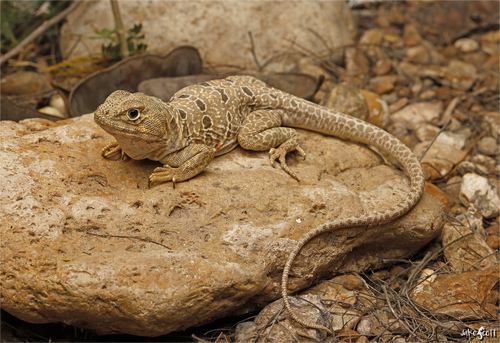
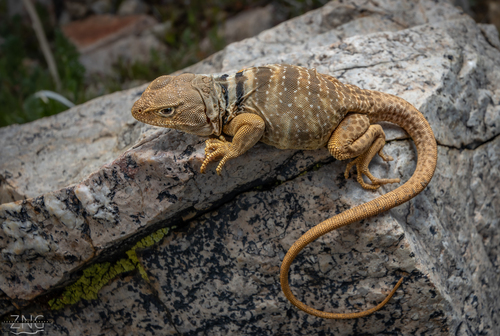
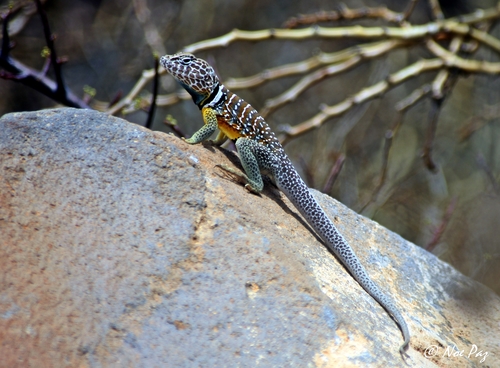
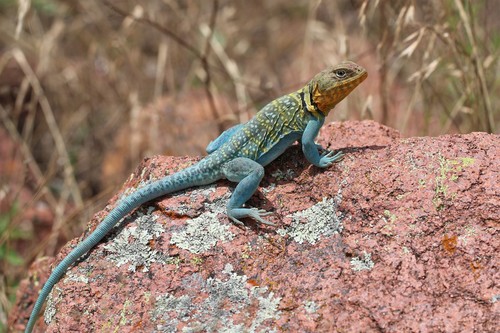
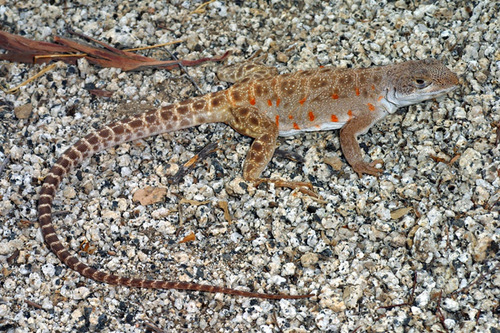
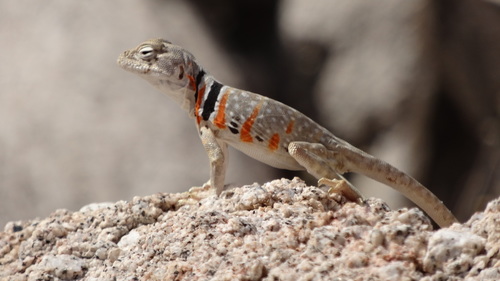
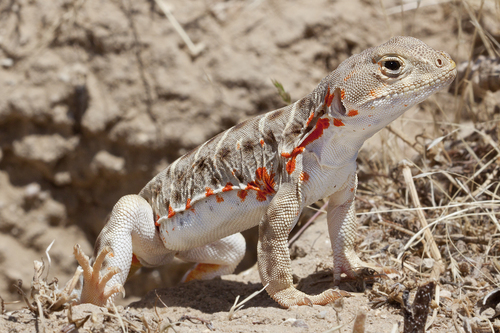
The blunt-nosed leopard lizard, scientifically known as Gambelia sila, is a relatively large lizard belonging to the family Crotaphytidae. This species has a long, regenerative tail, long powerful hind limbs, and a short, blunt snout. Adult males are slightly larger than females. When measured excluding the tail, adult males range from 3.4 to 4.7 inches (86 to 119 mm) in length, while females range from 3.4 to 4.4 inches (86 to 112 mm). Males weigh 1.3 to 1.5 ounces (37 to 43 g), and females weigh 0.8 to 1.2 ounces (23 to 34 g). Although blunt-nosed leopard lizards are darker than other leopard lizard species, they show very high variation in dorsal color and patterning. Their background color ranges from yellowish or light gray-brown to dark brown, matching the color of the surrounding soil and the local vegetation. Their underside is solid, uniform white. They have rows of dark spots across their backs, alternating with white, cream-colored, or yellow bands. Gambelia sila is unusual among crotaphytids because the sexes cannot be told apart by permanent coloration or patterning. However, both males and females develop distinct breeding coloration, and these breeding colors and patterns differ noticeably between the two sexes. Additionally, unlike almost all other crotaphytids, juvenile G. sila develop yellow coloring on the underside of their hind limbs and tails. The presence of this yellow color in young individuals has been hypothesized to send a signal to adult blunt-nosed leopard lizards, though this hypothesis has not been tested. It has been suggested that the yellow color signals to adults that the juveniles are too small to breed, and therefore do not act as competitive rivals. Alternatively, the bright yellow color of juveniles may function to help them avoid predators. Gambelia sila is found exclusively in Southern California. Historically, its range covered the San Joaquin Valley and adjacent foothills, extending from southern Stanislaus County to the northern tip of Santa Barbara County. This species only occurs at elevations of 800 meters (2,600 feet) and below. Today, G. sila is restricted to isolated patches of undeveloped land within the San Joaquin Valley. In the northern San Joaquin Valley, it can be found in the Ciervo Hills, Tumey Hills, Panoche Hills, Anticline Ridge, Pleasant Valley, and the Lone Tree, Sandy Mush Road, Whites Bridge, Horse Pasture, and Kettleman Hills Essential Habitat Areas. In the southern San Joaquin Valley, it occurs in Pixley National Wildlife Refuge, Liberty Farm, Allensworth, Kern National Wildlife Refuge, Antelope Plain, Buttonwillow, Elk Hills, Lost Hills, and Tupman Essential Habitat Areas; on the Carrizo and Elkhorn Plains; north of Bakersfield around Poso Creek; in western Kern County near the towns of Maricopa, McKittrick, and Taft; at the Kern Front Oil Field; at the base of the Tehachapi Mountains on the Tejon Ranch; and just west of the California Aqueduct on the Tejon Ranch and Rancho San Emidio.