About Gallus varius (Shaw, 1798)
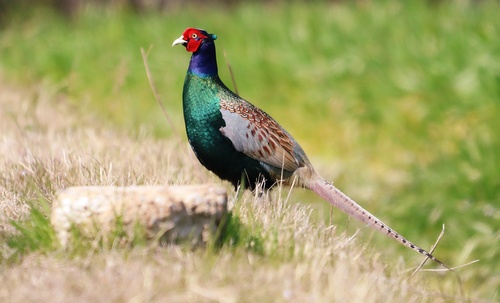
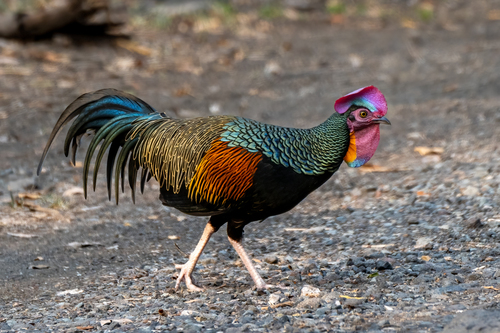
Green junglefowl (Gallus varius) has sexually dimorphic colouration. From a distance, the male’s plumage appears dark and blackish. When viewed closer, it shows an iridescent mantle of gleaming scale-like markings, similar in colour and pattern to those of ocellated turkeys and green peafowl. Each scale has a vivid blue base, shifting through various shades of gold and bronzed green. Specialized plumes framing the male’s throat are highly reflective of light, appearing violet on their proximal (inner) sections and sky blue on their distal (outer) edges. The wing’s lesser coverts are a distinct burnt orange with bronzed black centers, and the distal edges of the greater secondary coverts are a vivid ocher. Just like the related red junglefowl, the breast and ventral regions of green junglefowl are dense, light-absorbing black. Like its closer relative, the Sri Lankan junglefowl, the male green junglefowl has clear bare facial skin "windows" that stand out against the dark scarlet red of the face. The comb of the green junglefowl has an ice blue center. A patch of bright electric yellow facial skin stretches below each ear, separating the plumed hackles from the gular lappet. Its head is topped by a light blue comb that fades to purple or red towards the top. Its wattle matches the comb’s general colour, but is edged with blue and tinted yellow closer to the throat. The female is mostly brown, with occasional green feathers, and has no comb. Green junglefowl is endemic to Java, Bali, Lombok, Komodo, Flores, Rinca and the small islands that connect Java with Flores, Indonesia. It has been introduced to the Cocos (Keeling) Islands, where a small wild population exists. In its native range, it occurs at natural altitudes from 0 to 2000 m, in subtropical or tropical lowland moist forest, shrubland, and arable land. It has been observed flying between islands within its native range, and lives and breeds along coastal areas.