About Gallus lafayettii R.Lesson, 1831
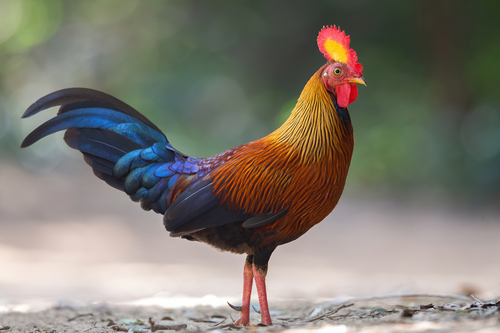
Like other junglefowl, Sri Lankan junglefowl (Gallus lafayettii) are strongly sexually dimorphic. Males are much larger than females, have more vivid plumage, and greatly exaggerated wattles and combs. Adult males measure 66–72 cm (26–28 in) long and weigh 790–1,140 g (1.74–2.51 lb), and look essentially like large, muscular roosters. Males have orange-red body plumage, with dark purple to black wings and tail. The mane feathers running from the head down to the base of the spine are golden, the face has bare red skin and wattles, and the comb is red with a yellow center. Like green junglefowl, male Sri Lankan junglefowl do not grow an eclipse plumage. Females are much smaller, measuring only 35 cm (14 in) long and weighing 510–645 g (1.124–1.422 lb). They have dull brown plumage with white patterning on the lower belly and breast, which provides ideal camouflage for a nesting bird. This species is common in forest and scrub habitats, and is often spotted at locations including Kitulgala, Yala, and Sinharaja. It can be found from sea level up to 2,000 meters in elevation. The reproductive strategy of Sri Lankan junglefowl is best classified as facultative polyandry. A single female typically associates with two or three males that form a group similar to a pride, and these males are likely siblings. The female pairs with the alpha male of the group and builds her nest high above the ground. The species' eggs vary greatly in color, but are generally cream-colored with a yellow or pink tint, and often have purple or brownish spots. Occasionally, females lay red eggs or blotched eggs. The female hen incubates the eggs, while the alpha male guards the nest from a nearby perch during the nesting season. Beta males stay close to the nest and guard the nesting territory from intruders or potential predators, such as rival males, snakes, and mongooses. Sri Lankan junglefowl are unique among junglefowl for their short incubation period: incubation can be as short as 20 days, compared to the 21–26 day incubation period of green junglefowl. Chicks need a constant diet of live food, usually insects and isopods like sowbugs and pillbugs. Juvenile land crabs are also particularly important for the growth and survival of young and subadult Sri Lankan junglefowl. In captivity, this species is especially vulnerable to the poultry disease caused by the bacteria Salmonella pullorum, as well as other bacterial diseases common in domestic poultry. Chicks, and to a slightly lesser degree adults, cannot process vegetable-based proteins and fats. Their dietary needs cannot be met by commercial processed feeds, so the species is exceedingly rare in captivity.