About Gallus gallus (Linnaeus, 1758)
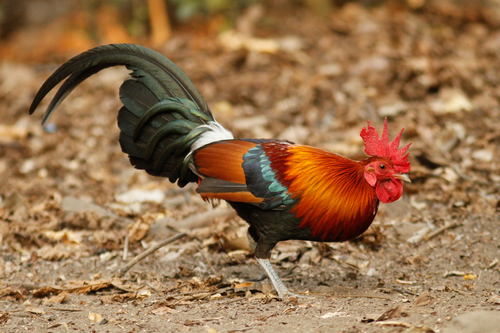
Gallus gallus, the red junglefowl, shows strong sexual dimorphism: males are called roosters and females are called hens. Compared to domestic chickens, red junglefowl have much smaller body masses. Roosters are significantly larger than hens: males weigh around 1.5 kilograms (3.3 lb), while females weigh around 1 kilogram (2.2 lb). Male plumage is far brighter than female plumage; female plumage is a dull drab color that works well for camouflage. A rooster's mantle, which covers the neck and back, typically has long, golden hackle feathers. Its tail has 14 iridescent feathers that shimmer with blue, purple, and green when in direct light. Some of these tail feathers are long and curved, and can grow up to 28 centimetres (11 in) in length. An adult red junglefowl can reach a total length of 70 centimetres (28 in). Hens do not have the long, ornate feathers that are a prominent feature of roosters. Male plumage coloration varies somewhat between different subspecies: for example, some subspecies have golden yellow covert feathers from the neck to the lower back and greenish-black tail feathers, while others have red body plumage and black tails. Around June, breeding adult red junglefowl molt into an eclipse plumage pattern that lasts through October. The male eclipse pattern includes black feathers on the back and small red-orange plumes spread across the mantle. A hen's eclipse plumage is generally indistinguishable from her plumage in other seasons, but hens follow the same molting schedule as roosters. Males have much larger combs and wattles, which are fleshy head ornaments that signal good health to rivals and potential mates, than females do. Roosters have a sharp, bony spur growing on the back of each leg, just behind and above the foot. These spurs are used to defend against predators and to establish dominance within the flock. The native geographic range of the red junglefowl stretches from Pakistan, India, Nepal, Bhutan, and Bangladesh in the west, east across southern China to Myanmar, Thailand, Cambodia, Laos, and Vietnam, and south and southeast into Malaysia, Singapore, the Philippines, Indonesia, and Timor-Leste. This species has also been introduced to Australia, the Dominican Republic, Fiji, Hawaii, Jamaica, the Marshall Islands, Micronesia, Nauru, the Northern Mariana Islands, Palau, and Puerto Rico. Red junglefowl prefer disturbed habitats and habitat edges, both those that are natural and those created by human activity. The available forage and thick cover found in these areas are attractive to junglefowl, especially nesting females. They use both deforested and regenerating forests, and are often found near human settlements or areas that have regrown after slash-and-burn agriculture. Areas burned to promote bamboo growth also attract red junglefowl, since these areas have more available edible bamboo seeds. In some regions, red junglefowl are absent from silvicultural and rubber plantations; in other regions, they can be found in both tea plant and palm oil plantations. In the state of Selangor, Malaysia, palm foliage provides suitable cover, palm nut fruit provides enough food, and insects and their larvae are also available within and adjacent to the palm trees. Palms also provide a variety of roost sites, ranging from the low perches (around 4 m) preferred by females with chicks to the higher perches (up to 12 m) used by other adult birds. Red junglefowl drink surface water when it is available, but they do not require it to survive. In north-central India, red junglefowl visit water holes frequently during the dry season, though not all junglefowl on the Indian subcontinent live close enough to water to do this, and population densities can be lower in areas where surface water is limited. When a male finds food in the presence of a female, he performs a food-related courtship display called tidbitting. This display consists of coaxing, cluck-like calls, and noticeable bobbing and twitching movements of the head and neck. During the display, the male repeatedly picks up the food item with his beak and drops it again. The display usually ends when the hen takes the food item either from the ground or directly from the male's beak, and mating sometimes occurs after this display. In many regions, red junglefowl breed during the dry part of the year, typically winter or spring; this breeding pattern holds true for parts of India, Nepal, Thailand, Vietnam, and Laos. However, year-round breeding has been recorded for red junglefowl in palm oil plantations in Malaysia, and year-round breeding may also occur in other locations. During the laying period, female red junglefowl lay one egg per day. Eggs take 21 days to develop before hatching. Chicks fledge at about 4 to 5 weeks old. When chicks reach 12 weeks old, their mother chases them out of the group, and the juveniles then either start a new group or join an existing one. Red junglefowl reach sexual maturity at 5 months old, with females taking slightly longer than males to reach maturity. Dominant males attempt to keep exclusive reproductive access to females, but in one study of a free-ranging feral flock in San Diego, California, females chose to mate with subordinate males around 40% of the time.