About Galloperdix spadicea (J.F.Gmelin, 1789)
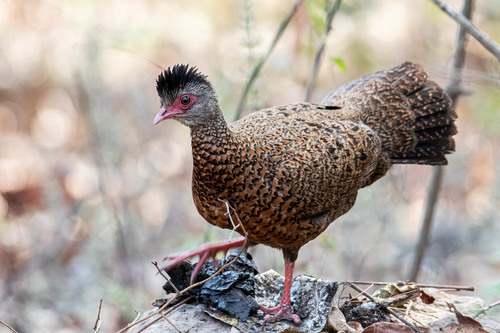
This large, partridge-like bird is overall reddish-brown, with a somewhat long tail. Its upper parts are brown with dark barring, while males have greyer faces and necks. The underside is rufous with dark markings. Both sexes have a red facial skin patch and red legs with one or two spurs; rarely, there may be three or four spurs, and females may have no spurs at all. Downy chicks have an unmarked cinnamon brown head, with a dark brown band along the back bordered by creamy stripes edged with thin lines of dark brown. The male of the distinctive Kerala subspecies G. s. stewarti has entirely chestnut plumage, including head feathers. Both sexes have long feathers on the crown that can be erected into a crest. The species is found across India south of the Ganges, in scrub and dry and moist-deciduous forests, often in hilly country. It prefers areas with good undergrowth, including undergrowth formed by the invasive plant Lantana. Red spurfowl usually forage in small parties of three to five. When walking, the tail is sometimes held vertically like that of domestic fowl. They are mostly silent during the day, calling only in the mornings and evenings. They feed on fallen seeds, berries, mollusks, and insects, and swallow grit to aid digestion. When flushed, they usually fly only a short distance, and stay within well-defined territories throughout the year. They roost in trees. Their calls include the distinct pattern ker-wick...kerwick... and harsh karr...karrr... notes. The Marathi name for the species, Kokatri, has an echoic origin. The breeding season runs from January to June, mainly before the rains. As a ground-nesting bird, it lays 3 to 5 eggs in a ground scrape. Males are monogynous, which usually indicates greater male investment in parental duties, but males do not incubate eggs. Males have been observed distracting predators when females and chicks are nearby. The widespread nematode Heterakis gallinae has been recorded in this species held in captivity, while Ixodid ticks have been found on wild individuals. The helminth species Lerouxinema lerouxi was described with the red spurfowl as its type host. Keratinophilic fungi such as Ctenomyces serratus have also been recorded from the species.