About Gallirallus australis (Sparrman, 1786)
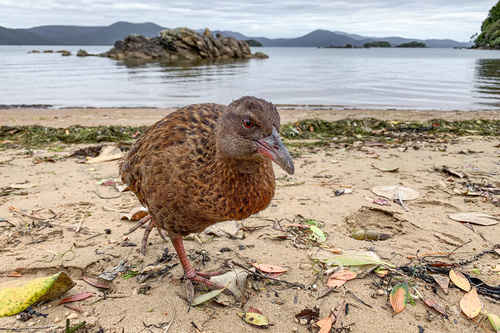
Weka are large members of the rail family. Their plumage is predominantly rich brown, mottled with black and grey, and the exact shade of brown varies from pale to dark across different subspecies. Males are larger than females, measuring 50–60 cm (20–24 in) in length and weighing 532–1,605 g (1.173–3.538 lb). Females are 46–50 cm (18–20 in) long and weigh 350–1,035 g (0.772–2.282 lb). Their reduced wings give a wingspan ranging from 50 to 60 cm (20 to 24 in). Their relatively large, reddish-brown beak is around 5 cm (2.0 in) long, stout, tapered, and used as a weapon. Weka have pointed tails that are almost constantly flicked, a sign of unease that is characteristic of the rail family, plus sturdy legs and reduced wings. The common name 'weka' comes from the Māori language. The species was originally described as Rallus australis by Anders Erikson Sparrman in 1789, when he published the finding in Museum Carlsonianum, a work of four fascicules based on specimens collected during voyages with Captain James Cook between 1772 and 1775. The species epithet australis is Latin for 'southern'. In 1830, Johann Georg Wagler proposed placing weka in the genus Ocydromus, treating each form as a separate species, and this classification was generally adopted. Later, however, weka were reclassified as a single species in the genus Gallirallus, with four recognized subspecies. The buff weka (Gallirallus australis hectori) formerly lived in the eastern districts of the South Island, but is now restricted to Chatham Island and Pitt Island, where it was introduced in the early 1900s; as a non-native species there, it is widely hunted and eaten in autumn. Past reintroduction attempts to Canterbury have not been successful so far, but introductions to Mou Waho Island in Lake Wānaka in 2004, followed by translocations from Mou Waho to Pigeon Island and Pig Island in Lake Wakatipu in 2005/2006, have been much more successful. Buff weka have lighter overall colouring than the other three subspecies. The North Island weka (G. a. greyi) has original native populations in Northland and Poverty Bay, and has been released into other areas from this original stock. This subspecies is distinguished by greyer underparts, and brown rather than reddish legs. Individual sightings in the Dunedin area suggest that a small number of North Island weka may live in the southeastern South Island; these are either hidden or accidental introductions, or possibly remaining members of a population previously thought extinct. The nominate subspecies, the western weka (G. a. australis), occurs mainly in the northern and western regions of the South Island, ranging from Nelson to Fiordland. It can be identified by dark red-brown and black streaking on the breast, and has two distinct colour phases; populations in the southernmost part of its range show a greater degree of black colouring. The Stewart Island weka (G. a. scotti) is smaller than the other subspecies. Like the western weka, it has two colour phases: a chestnut form similar to the chestnut-phase western weka, and a black phase that is less dark than the black phase of the western weka. Reintroduced populations of Stewart Island weka are limited to Stewart Island and its outlying islands, plus Kapiti Island where the subspecies was introduced. Weka host two species of feather lice: Rallicola harrisoni and Pseudomenopon pilgrimi. These louse species share the same north-south population structure that is seen in their weka hosts. Weka live in a range of habitats including forests, sub-alpine grassland, sand dunes, rocky shores, and modified semi-urban environments. They are omnivorous, with a diet made up of 30% animal foods and 70% plant foods. Animal foods in their diet include earthworms, larvae, beetles, wētā, ants, grass grubs, slugs, snails, insect eggs, slaters, frogs, spiders, rats, mice, and small birds. Stewart Island weka (G. a. scotti) have been observed preying on the eggs and chicks of sooty shearwaters (Puffinus griseus). Plant foods eaten by weka include leaves, grass, berries, and seeds. Weka play an important role as seed dispersers in forest ecosystems, dispersing seeds that are too large for smaller berry-eating birds to carry. In areas where weka are relatively common, their furtive curiosity leads them to search around houses and camps for food scraps, or any unfamiliar object they can carry. They are particularly known for taking shiny objects.