About Gallinula ventralis Gould, 1837
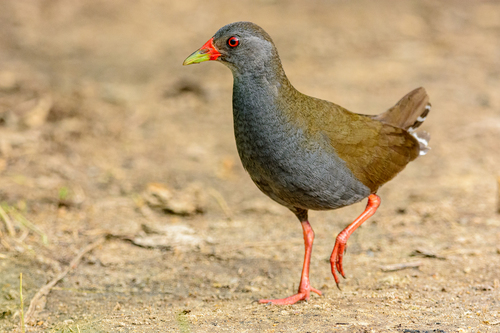
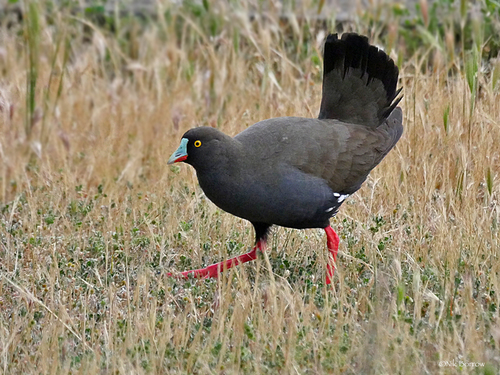
The black-tailed nativehen, scientifically named Gallinula ventralis Gould, 1837, is a large, dark bird. It reaches approximately 38 centimeters in length and weighs around 400 grams (0.88 lb). This species holds its tail erect, and its body is covered almost entirely in brownish-grey and green feathers. Its long legs and lower jaw are a prominent pink-orange, and its eyes are bright orange. This species is not highly vocal; its main call is an alarm call described as 'kak'. They become noticeable when seen in small flocks on the ground. Their erect tails and social behaviour resemble that of domestic hens. This is a nomadic species that follows seasonal water sources, and it lives near fresh and brackish water year-round. The black-tailed nativehen is common across Australia, where it inhabits both permanent and intermittent water sources. It has a large range, with an estimated global extent of occurrence of 1,000,000 to 10,000,000 km². The IUCN classifies this species as Least Concern. It is a rare vagrant to New Zealand, and an occasional visitor to Tasmania. Breeding most often occurs between August and December, or when local conditions are favourable. It builds a cup-shaped nest in vegetation near water or swampland. Females lay 5 to 7 pale green eggs, which are incubated for approximately 20 days.