About Gallinula chloropus galeata (Lichtenstein, 1818)
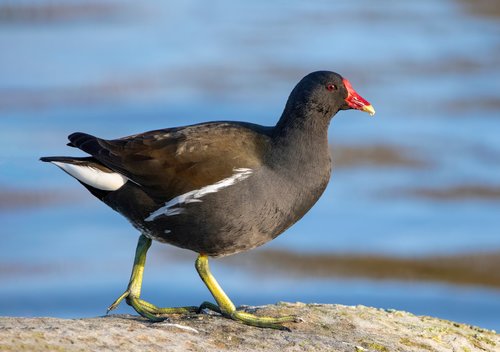
This description covers the common moorhen, a midsized to large rail species that measures 30 to 38 cm (12 to 15 in) in length, has a wingspan of 50 to 62 cm (20 to 24 in), and a body mass ranging from 192 to 500 g (6+3⁄4 to 17+3⁄4 oz). Adult common moorhens are distinctive, with mostly black and brown plumage, plus a white under-tail, white streaks on the flanks, yellow legs, a red frontal shield, and a red bill with a yellow tip. Juvenile common moorhens are browner and do not have the red shield. For adult common moorhens, the top of the frontal shield is rounded, its sides are fairly parallel, and the tailward margin of the red unfeathered area forms a smooth waving line. Several subspecies differ in appearance from the nominate subspecies: G. c. meridionalis is smaller, has slaty blue-grey upperwing coverts, and lacks an olive wash; G. c. orientalis is similar to G. c. meridionalis but has a larger frontal shield; G. c. pyrrhorrhoa is darker than the nominate and has buff undertail coverts. The related American common gallinule (Gallinula galeata) has a frontal shield with a fairly straight top that narrows toward the bill, creating a clear indentation on the back margin of the red area. Common moorhens produce a wide range of gargling calls, and will give loud hisses when threatened. This is a common resident and breeding bird that occupies marsh environments, rivers, well-vegetated lakes, and even city parks. Populations in regions with freezing water, such as eastern Europe, migrate to more temperate climates. In China, common moorhen populations are largely resident south of the Yangtze River, while northern populations migrate south for winter; these Chinese populations have high genetic diversity. Common moorhens eat a wide variety of vegetable material and small aquatic creatures. They forage beside or in the water, sometimes walking on lilypads or upending in the water to feed. They are often secretive, but can become tame in some areas. Despite habitat loss in parts of its range, the common moorhen remains plentiful and widespread.