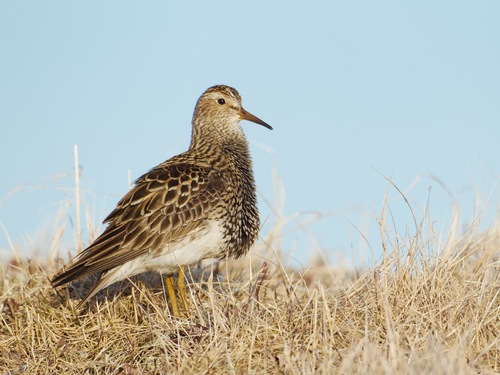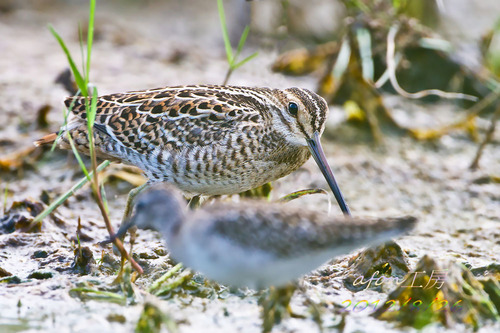
About Gallinago stenura (Bonaparte, 1831)
This species, scientifically named Gallinago stenura (Bonaparte, 1831), is a bird measuring 25 to 27 centimeters in length. It resembles the common snipe, which has a longer bill and longer tail than this species. Adult pin-tailed snipes have short greenish-grey legs and a long, straight, dark bill. Their upper body is mottled brown, with cream-colored lines running down the back. Underparts are pale, with a streaked buff breast and white belly. A dark stripe runs through the eye, with light stripes positioned both above and below this dark stripe. The sexes have similar appearance, and immature individuals differ only in minor plumage details. Compared to the common snipe, pin-tailed snipes have less pointed wings that lack the white trailing edge found on common snipe wings. When flushed, their shorter tail and flatter flight path also make it relatively easy to distinguish them from common snipe in flight. Male pin-tailed snipes often display in groups, producing a loud repetitive tcheka song that builds into a crescendo of fizzing and buzzing sounds. They also produce whistling noises during flight using their pin-like outer tail feathers, which are the feature that gives this species its English common name. The species' usual call is a weak squik. Pin-tailed snipes breed in northern Russia and migrate to spend the non-breeding season in southern Asia, ranging from Pakistan to Indonesia. It is the most common migrant snipe in southern India, Sri Lanka, and much of Southeast Asia. It occurs as a vagrant in north-western and northern Australia, and in Kenya in East Africa. Its breeding habitat is damp marshes and tundra in Arctic and boreal Russia. In the non-breeding range, pin-tailed snipes use a variety of wetlands, and they often occur alongside common snipe. They may also be found in drier habitats than the common snipe occupies. They build their nests in well-hidden locations on the ground. Pin-tailed snipes forage in mud or soft soil, probing for food or picking food up by sight. They mainly eat insects and earthworms, and also consume some plant material.