About Gallinago solitaria Hodgson, 1831
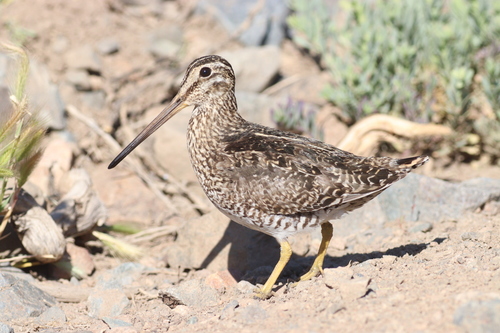
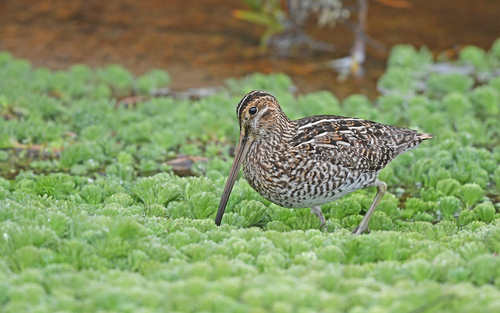
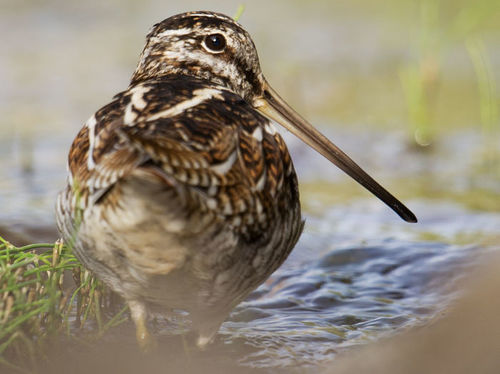
This description covers Gallinago solitaria Hodgson, 1831, commonly known as the solitary snipe. It is a large, heavy snipe that measures 29–31 cm in length, with a stocky body and relatively short legs for a wader. Its upperparts, head, and neck are streaked and patterned with medium brown stripes; feathers have whitish edges that form lines running down its back. The face is whitish. The breast is ginger-brown, while the belly is white with brown barring on the flanks. The long, straight, fairly slender bill is brown and black. The legs and feet range from yellowish-olive to yellowish-brown. All plumages are similar across the species, though females average larger in size. There are two fairly similar subspecies: the nominate G. s. solitaria, which has a very wide distribution, and G. s. japonica. G. s. japonica is richer red and has less white on its upperparts; its breeding range is not known, but it winters in Japan. When taking off, the solitary snipe produces a hoarse kensh call. During display, it gives a far-carrying chok-a-chok-a call. It has a relatively slow, heavy flight. The solitary snipe breeds discontinuously in the mountains of eastern Asia, specifically in eastern Russia, Kazakhstan, Kyrgyzstan, and Mongolia. Many individuals are sedentary in high mountains, or only move downhill during severe weather. Other individuals are migratory, and winter in northeast Iran, Pakistan, northern India, Bangladesh, eastern China, Korea, Japan, and Sakhalin.