About Gallicrex cinerea (Gmelin, 1789)
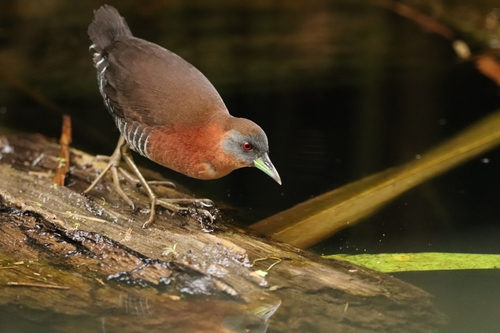
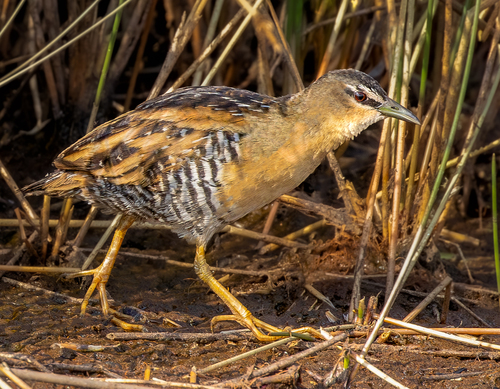
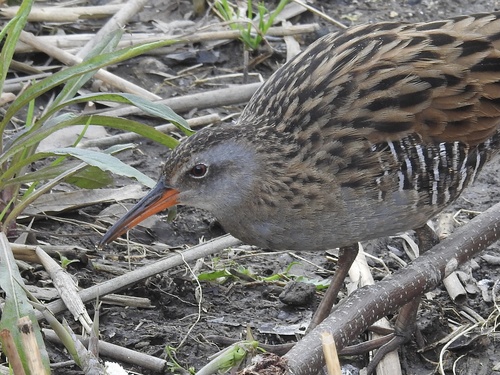
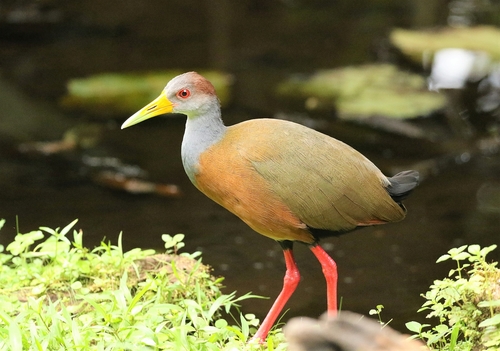
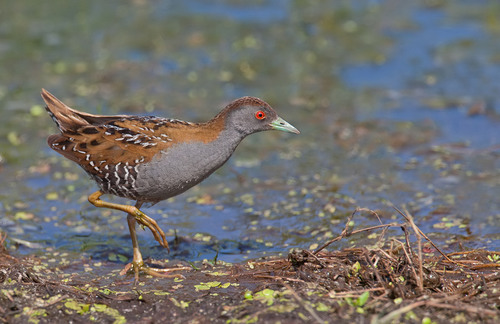
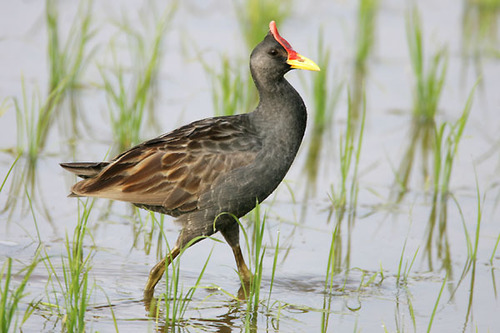
Gallirallus cinerea, commonly called the watercock, is a rail species with distinct size and plumage differences between adult males, young males, adult females, and chicks. Adult male watercocks measure 43 cm (17 in) in length and weigh 476–650 g (1.049–1.433 lb). Their plumage is mostly black-grey, and they have red legs, a red bill, an extended red frontal shield, and a red horn. Young male watercocks are buff-colored, and their plumage darkens as they mature. Young males have yellow bills and green legs. Adult female watercocks are smaller than adult males, reaching 36 cm (14 in) in length and weighing 298–434 g (10.5–15.3 oz). Females are dark brown on their upper bodies and paler on their under bodies. Their plumage has streaks and bars of darker markings. Females have yellow bills and green legs. Downy watercock chicks are black, which matches the trait seen in all rail species. Like other rails, watercocks have laterally flattened bodies that make it easier for them to move through reeds and undergrowth. They also have long toes and a short tail. Watercocks are typically quite secretive, but they are occasionally spotted in open areas. They are noisy birds, particularly at dawn and dusk, and produce a loud, gulping call. Their breeding habitat consists of swamps across south Asia, ranging from India, Pakistan, and Sri Lanka to south China, Korea, Japan, the Philippines, and Indonesia. These large rails are mostly permanent residents across their entire range. When foraging, watercocks probe mud or shallow water with their bills, and also pick up food by sight. They forage on the ground, and their diet mainly consists of insects, small fish, and seeds.