About Galictis cuja (Molina, 1782)
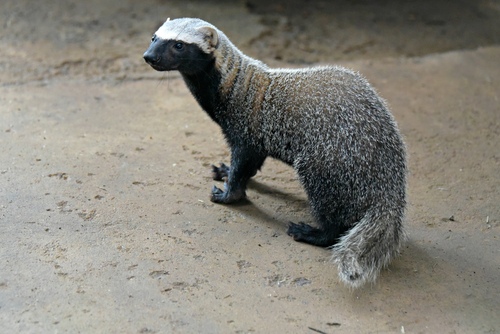
Lesser grisons (Galictis cuja) have a long, slender body, short legs, a bushy tail, a long neck, and a small head with a flattened forehead and rounded ears. They are smaller than their close relative, the greater grison. Their head-body length ranges from 27 to 52 cm (11 to 20 in), their tails measure 14 to 19 cm (5.5 to 7.5 in) long, and adult individuals weigh between 1.2 and 2.4 kg (2.6 to 5.3 lb). Females are slightly smaller and more slender than males. The top of the head, back, flanks, and tail are covered in coarse black guard hairs with buff-colored tips over a softer undercoat, giving these regions a grizzled, greyish appearance. The rest of the body is black or nearly black, except for a pale buff-colored stripe that runs from the forehead to the shoulders along the lower edge of the grey-furred area. Their feet are webbed, with five toes that end in sharp, curved claws. Lesser grisons live across most of southern South America, ranging from sea level up to 4,200 m (13,800 ft) in elevation. They occupy a wide variety of habitats, and are generally found near water. Their habitats include grasslands, forests, scrub, and mountain meadows, and they are also known to live on agricultural land and pasture in some areas. Four subspecies of Galictis cuja are currently recognized: G. c. cuja, found in southwestern Bolivia, western Argentina, and central Chile; G. c. furax, found in southern Brazil, northeastern Argentina, Uruguay, and Paraguay; G. c. huronax, found in south-central Bolivia and eastern Argentina; and G. c. luteola, found in extreme southern Peru, western Bolivia, and northern Chile.