About Galerida cristata (Linnaeus, 1758)
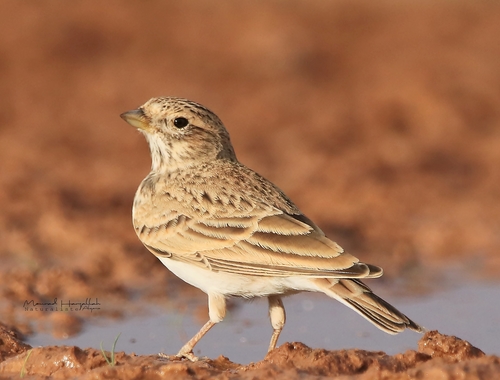
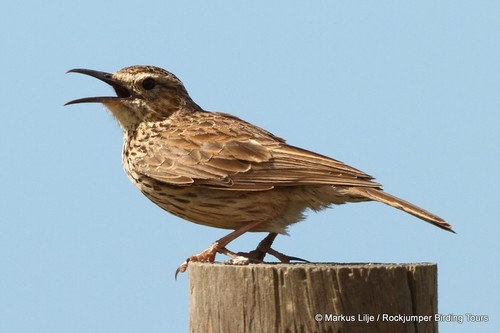
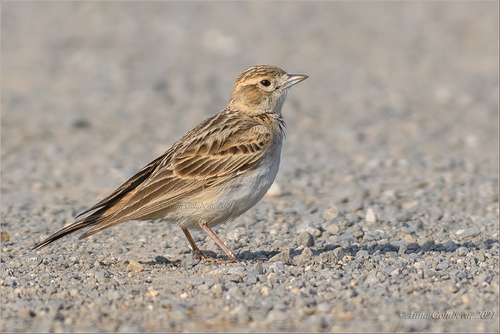
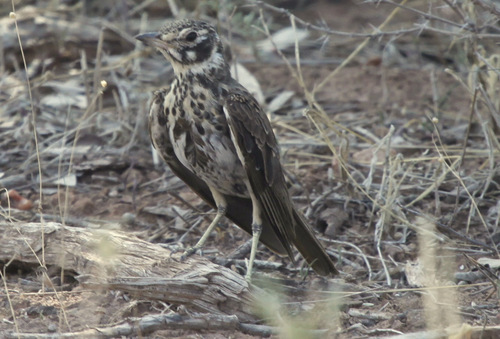
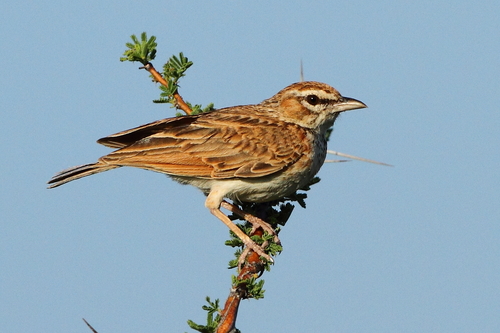
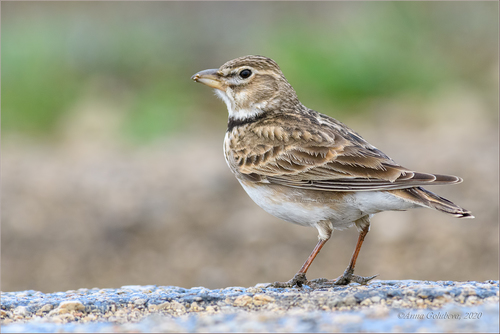
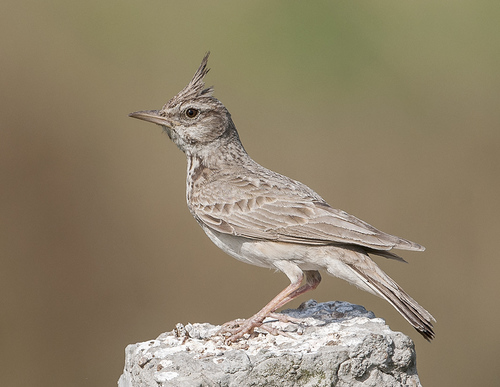
Galerida cristata, commonly called the crested lark, is a fairly small lark that is roughly the same size as the Eurasian skylark, but is shorter overall and bulkier through the head and body. It reaches 17 cm (6.7 in) in height, has a wingspan of 29 to 38 cm (11 to 15 in), and weighs between 37 and 55 g (1.3 and 1.9 oz). This small brown bird has a short tail with light brown outer feathers. There are no notable physical differences between adult males and females, but young crested larks have more spots on their backs than older individuals. The species' plumage is downy but sparse, and appears whitish. The distinct crest that gives the crested lark its name is visible at all times, but becomes more pronounced during territorial or courtship displays and when singing. In flight, crested larks show reddish underwings. The crested lark shares many traits with the Thekla lark; the main differences between the two are the shape of the beak, the heavier black-brown streaks of the Thekla lark, and the grey underwing seen in European Thekla lark specimens. The crested lark breeds across most of temperate Eurasia, ranging from Portugal to northeastern China and eastern India, and in Africa south to Niger. This species is non-migratory, and its sedentary habit is demonstrated by its status as a very rare vagrant to Great Britain, even though it breeds as close to Britain as northern France. While it is not commonly found in Scandinavia today, crested larks could be found in Sweden until the 1990s; sources recorded six individual birds in 1992, before the species was extirpated from Sweden in 1993. It has also been extirpated from several other European countries: Norway in 1972, Luxembourg in 1973, and Switzerland in the 1980s. The crested lark is a common species of dry, open country. It is often spotted along roadsides or in cereal fields, and also occupies small sandy patches near railways, docks, and airfields. Crested larks are largely vegetarian, and primarily feed on grains and seeds including oats, wheat, and barley. They will also eat insects, particularly beetles. They obtain food either by scavenging from the ground or by digging it up. Both parents feed juvenile crested larks, and juveniles generally leave the nest before they are able to fly to begin foraging for food on their own.