About Galeorhinus galeus (Linnaeus, 1758)
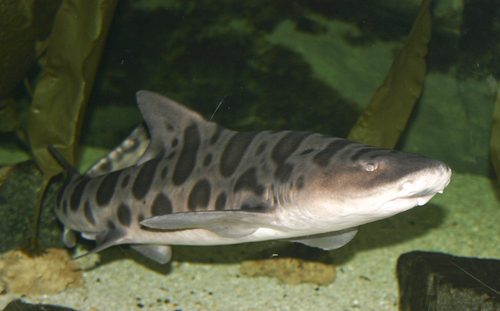
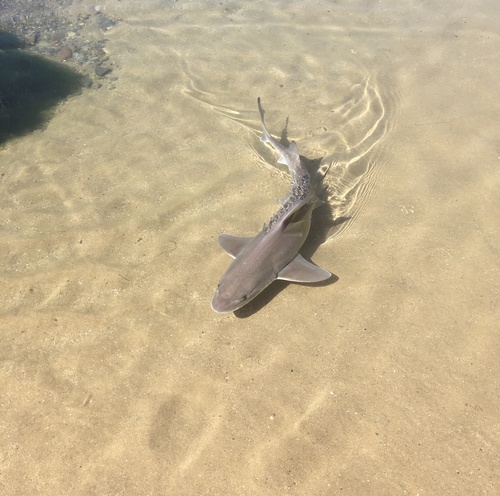
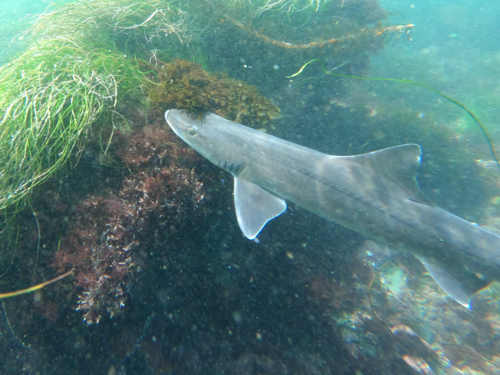
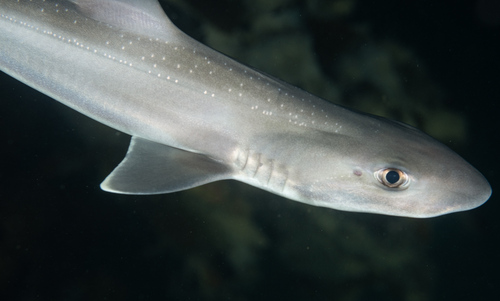
This species is Galeorhinus galeus (Linnaeus, 1758), commonly called the school shark. The school shark is a small, shallow-bodied shark with an elongated snout. It has a large crescent-shaped mouth, and teeth of the same size and shape in both its upper and lower jaws. These teeth are small, flat, triangular, set at an oblique backward-facing angle, have serrations, and bear a notch. Its spiracles are small. The first dorsal fin is triangular with a straight leading edge, and positioned just behind the pectoral fins. The second dorsal fin is roughly the same size as the anal fin, and sits directly above it. The terminal lobe of the caudal fin has a notch and is the same length as the rest of the fin. Adult school sharks are dark bluish grey on their upper dorsal surfaces and white on their ventral belly surfaces. Juveniles have black markings on their fins. Mature males range from 135 to 175 cm (53 to 69 inches) long, while mature females range from 150 to 195 cm (59 to 77 inches) long.
The school shark has a widespread distribution. It lives mainly near the seabed around coasts in temperate waters, reaching depths of around 800 m (2,600 ft). It can be found in the Northeast Atlantic and Mediterranean Sea, where it is uncommon; the Southwest Atlantic between Patagonia and southern Brazil; the coasts of Namibia and South Africa; the Northeast Pacific between British Columbia and Baja California; the Southeast Pacific off the coasts of Chile and Peru; and around the southern coasts of Australia (including Tasmania) and New Zealand.
Humans use the school shark in multiple ways. In New Zealand, it is a traditional Māori resource known in Māori as kapetā. Hapū would travel across Northland to special events at Rangaunu Harbour, where kapetā could be fished over two days. Its meat can be eaten fresh or preserved, and oil from its liver was mixed with botanicals and red ochre to make cosmetics. In Andalusian cuisine, school shark meat is consumed under the name cazón. Common preparations include the traditional mainland recipe cazón en adobo, and tollos from the Canary Islands. In Mexican cuisine, the term cazón refers to other species, which are prepared in the same way. In the United Kingdom, school shark flesh is sometimes used as a substitute for cod or haddock in fish and chips. In Greek cuisine, it is called galéos (γαλέος) and is typically served with skordalia (σκορδαλιά), a dip made from mashed potatoes or wet white bread, combined with mashed garlic and olive oil.
Before 1937, school sharks were caught in California to supply shark fillet to local markets, and their fins were dried and sold in eastern Asia. Around 1937, laboratory testing found that school shark liver had higher vitamin A content than any other fish tested at the time. Following this discovery, larger-scale commercial fishing of the species developed, driven by high prices for the fish and its liver. During World War II, school shark became the main source of vitamin A supply in the United States. However, the species was overexploited, its populations declined, and catch numbers dropped. Its oil was first replaced by a similar product from the spotted spiny dogfish (Squalus suckleyi), and later by lower-potency fish oils from Mexico and South America. Along with the gummy shark, the school shark is the most important species in the southern Australian commercial fishery. It is fished throughout its entire range and is heavily exploited.