About Galeopterus variegatus (Audebert, 1799)
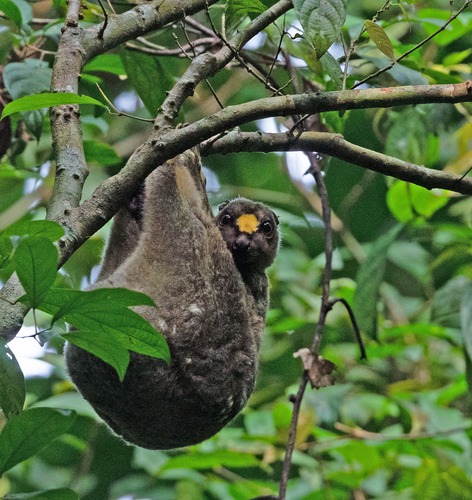
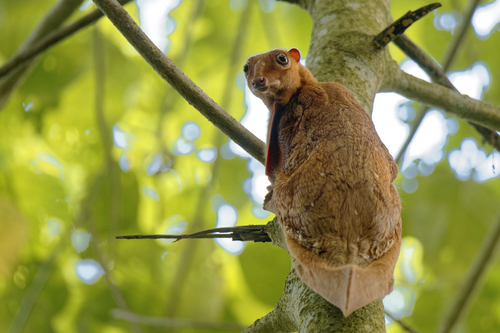
The Sunda flying lemur, scientifically named Galeopterus variegatus (Audebert, 1799), is a skillful climber but nearly helpless when on the ground. Its gliding membrane, called a patagium, is kite-shaped and connects from the neck, extends along the limbs all the way to the tips of the fingers, toes, and nails. The patagium is expanded to enable gliding: this species can glide over 100 meters while losing fewer than 10 meters of elevation. Its foot is dorsiflexed and abducted, and it has an abducted clawed grasp. This anatomy makes climbing trees easier and faster, which helps when the species searches for food or avoids predators. The Sunda flying lemur has a head-body length of around 33 to 42 cm (13 to 17 in), a tail length of 18 to 27 cm (7.1 to 10.6 in), hind legs measuring 6.5 to 7.3 cm (2.6 to 2.9 in) long, and a body weight between 0.9 to 1.3 kg (2.0 to 2.9 lb).
The Sunda flying lemur is widely distributed across Southeast Asia, ranging from the Sunda Shelf mainland to outlying islands, including northern Laos, Cambodia, Vietnam, Thailand, Peninsular Malaysia, Sabah, Sarawak, Singapore, Brunei, Indonesia's Kalimantan, Sumatra, Bali, Java, and many adjacent smaller islands. In contrast, the closely related Philippine flying lemur (C. volans) is only found in the southern parts of the Philippines. The Sunda flying lemur is adapted to a wide range of vegetation types: it can live in gardens, primary and secondary forest, rubber and coconut plantations, fruit orchards (called dusun), mangrove swamps, lowland and upland forests, general tree plantations, lowland dipterocarp forests, and mountainous areas. However, not all of these habitats can support large populations of colugos.
The Sunda flying lemur is primarily nocturnal, but is sometimes active during morning and afternoon hours. It can maneuver and navigate while gliding, but heavy rain and strong wind interfere with its gliding ability. Gliding typically takes place in open areas or high in the forest canopy, especially in dense tropical rainforest. The species needs a specific distance to glide and land to avoid injury. The highest landing forces occur after short glides; longer glides result in softer landings, because the Sunda flying lemur can use aerodynamic braking to slow itself. Gliding improves a colugo's access to scattered food resources in the rainforest, without increasing its exposure to terrestrial or arboreal predators. The Sunda flying lemur does most of its foraging in tree canopies, and may feed on several different tree species in a single night, or just a single species.
After a 60-day gestation period, the Sunda flying lemur gives birth to a single offspring. The young is carried on the mother's abdomen, held in place by a large skin membrane.