About Galega orientalis Lam.
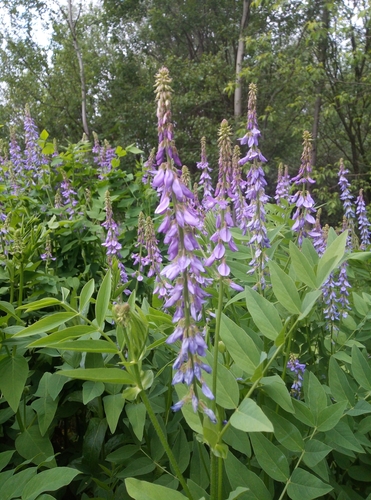
Galega orientalis Lam. is a perennial herb with a taproot and rhizome system. It grows stems reaching up to 2 meters tall, which branch near the middle. Its leaves are pinnate. The inflorescence can hold up to 70 lilac-colored flowers, and some cultivars may produce even more. Its fruit pods grow up to 4 centimeters long, and each pod holds up to 8 seeds, each a few millimeters in length.
In ecological terms, this species' flowers are pollinated by bees. It produces good quantities of both nectar and pollen, which makes it an excellent honey plant. The plant acts as a host for several fungal species; some of these fungi are pathogenic. Pathogenic species that infect it include Ascochyta sp., which causes blight, Fusarium oxysporum, which causes Fusarium wilt, and Botrytis cinerea, the cause of gray mould. Non-pathogenic fungal species hosted by this plant include Humicola brevis, Acremonium strictum, and Cladosporium cladosporioides.
This plant is cultivated as livestock feed. Its potential as a fodder crop was first proposed in 1908, and cultivation trials began near Moscow in the 1920s. It is productive, persistent, and nutritious, with a high protein content. It also contains high levels of carotene, minerals, and vitamins, particularly vitamin C. It produces multiple crops of vegetation over time, as its rhizome continuously generates new stems as it grows. It can be cut repeatedly to make hay and silage, and the remaining stubble can be grazed. However, the whole plant is generally not suitable for full grazing. It grows well as a companion plant with non-competitive grasses such as timothy or fescue. It is a particularly valuable forage crop in cold northern regions, because it produces new vegetation earlier in spring and continues growing later into autumn than many other forage species. It has a low concentration of toxic alkaloids, which makes it suitable for use as feed when its close alkaloid-rich relative Galega officinalis is not suitable for this purpose. The cultivar 'Gale', developed jointly by Estonian and Russian breeders, was released in 1987. The cultivars 'Vidmantai', 'Laukiai', and 'Melsviai' have been bred in Lithuania. This plant has been studied as a source of biogas, and trials have shown it produces a good yield when mixed with grasses and manure. It has also been tested for use in bioremediation of oil-polluted soils; some of the bacteria hosted by the plant can break down soil pollutants such as toluenes. It is also grown as an ornamental garden plant, and has been considered a promising prospective energy crop.