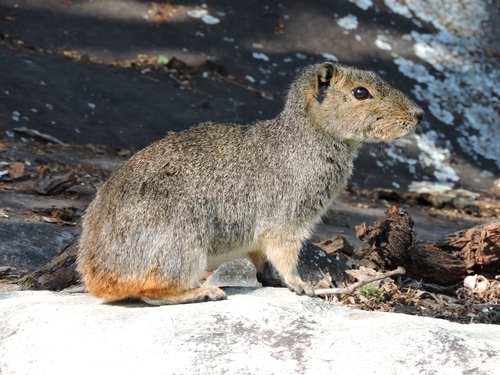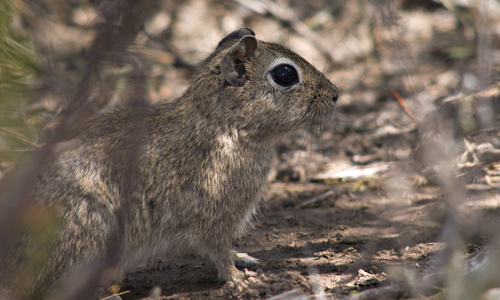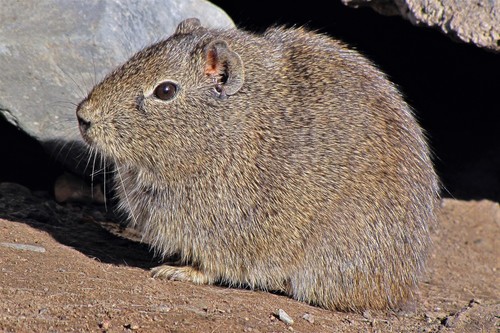
About Galea musteloides leucoblephara (Burmeister, 1861)
The common yellow-toothed cavy (Galea musteloides) is a rodent species in the family Caviidae, closely related to the domesticated guinea pig. This species is found in Argentina, Bolivia, Chile, and Peru, with a full range extending from southern Peru to central Argentina, and occurs at elevations from 20 to 5000 m above sea level. Its karyotype has 2n = 68 and FN = 136, and it has yellow teeth. It is the most common and most widely distributed member of the genus Galea. A recent study has recognized five subspecies of G. musteloides: boliviensis, demissa, leucoblephara, littoralis, and musteloides. These subspecies are distinguished based on pelage coloration, skull size and shape, auditory bullae size, and tooth shape. Growing evidence suggests that the lowland form previously classified as G. musteloides leucoblephara is actually an independent species, which should be called G. leucoblephara. The common yellow-toothed cavy is a diurnal, group-living herbivore about the size of a squirrel that occupies open habitats. It is mostly found in moist areas such as stream edges and croplands. At birth, female common yellow-toothed cavies average 37.6 g, while males average 36.4 g. G. musteloides first reproduces at one to three months of age, with a minimum reproductive age of twenty-eight days. Gestation lasts fifty-three days, lactation lasts three weeks, and average litter size is 2.7. In Peru, Galea musteloides sometimes associates with tuco-tucos of the genus Ctenomys, using tuco-tuco burrows and responding to tuco-tuco alarm calls, according to Sanborn and Pearson. In captive groups, G. musteloides develops separate hierarchical social orders for males and females. Alpha males regularly guard receptive females, but this guarding has little effect: usually other males also mate with the same female, and more than 80% of litters have multiple sires. In captivity, females are clearly promiscuous and always mate with multiple males in their group. In the wild, G. musteloides is clearly territorial, but it remains unclear whether a similar hierarchical social structure exists in wild populations, or if wild individuals live solitarily. Aggression between adult males occurs regularly. Adult male G. musteloides never participate in parental care, and are aggressive toward subadult males even when the subadults are their own very young offspring. Males are not aggressive toward females. Adult females lactate and nurse the offspring of other females during the offspring’s first week of life. Nearly all offspring receive some milk from females other than their own mother, though a female prioritizes care for her own offspring and continues caring for them longer than one week. Closely related Galea species have a range of mating systems from monogamy to promiscuity, making this genus suitable for comparative studies of mating systems. Two general trends have been identified from these studies: first, testis size relative to body size is larger in promiscuous species; and second, higher social tolerance in captive groups is associated with greater promiscuity and higher testosterone levels in males. Testosterone levels and aggression levels in males are not correlated, and females avoid males with higher than average aggression.