About Galbula dea (Linnaeus, 1758)
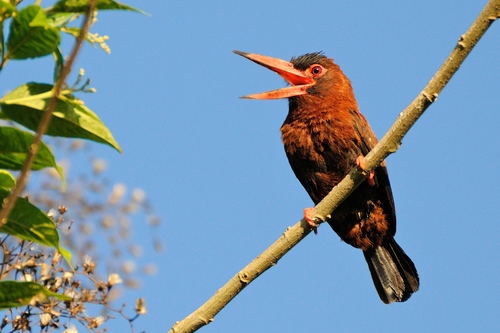
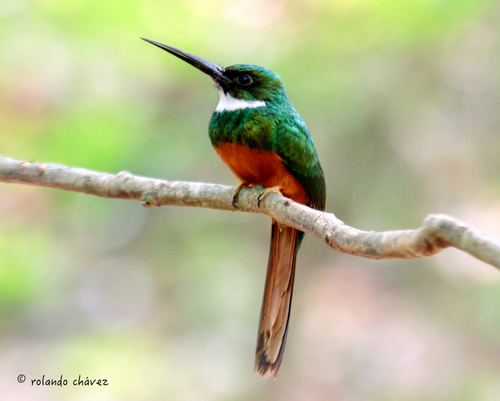
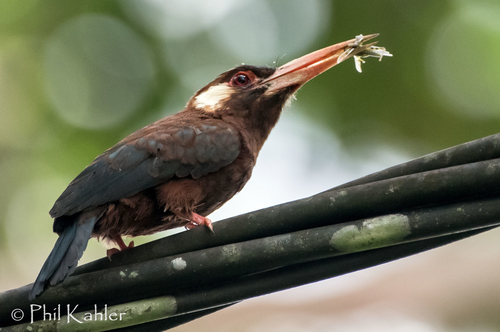
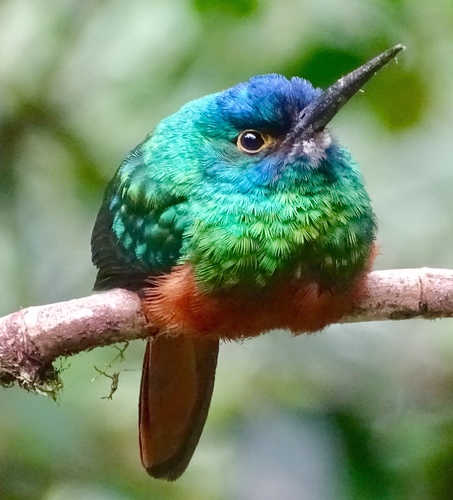
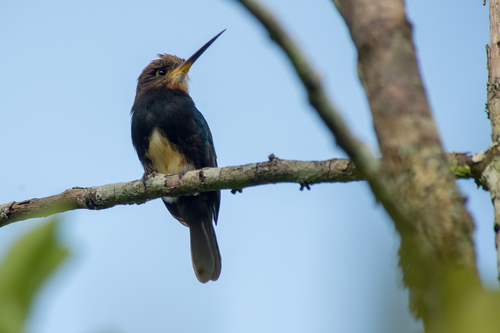
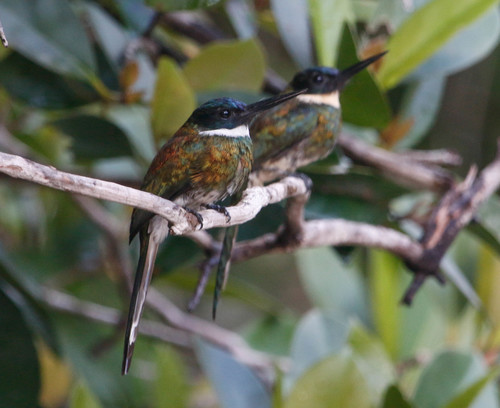
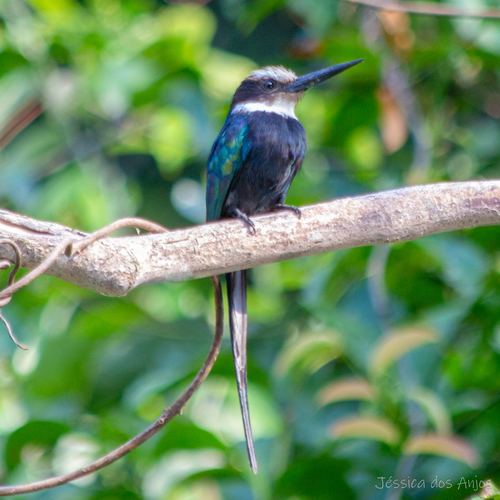
The paradise jacamar, Galbula dea, measures 25.5 to 34 cm (10.0 to 13.4 in) in length and weighs 25 to 32.5 g (0.88 to 1.15 oz). For the nominate subspecies, both sexes have a dark brown crown, with glossy black plumage covering the rest of their upper parts. Their throat and upper breast are white, and the remaining underparts are blackish. Other recognized subspecies differ in minor features: G. d. amazonum has a lighter crown and a more extensive white throat, and G. d. phainopepla resembles G. d. amazonum. G. d. brunneiceps has a lighter crown, with a bronzy greenish sheen on its upper parts. The paradise jacamar occurs across most of the Amazon Basin, with each subspecies occupying a distinct range. G. d. dea is found from the upper Orinoco River in southern Venezuela east through the Guianas, and in Brazil north of the Amazon River. G. d. amazonum ranges through north central Brazil south to northern Mato Grosso state and northern Bolivia. G. d. brunneiceps is distributed across southeastern Colombia, eastern Ecuador, eastern Peru, and western Brazil south of the Amazon and west of the Negro River. G. d. phainopepla occurs in western Brazil south of the Amazon and west of the Madeira River. This species mostly lives in terra firme, várzea, and savanna forests, including both primary and secondary forest. It can also be found in dry forest and gallery forest. It most often occurs along forest edges or in open areas such as clearings and treefalls, and is rarely found in forest interiors. Unusually for jacamars, it is mostly seen in the canopy rather than at mid levels of the forest. It is most commonly found below 500 m (1,600 ft) in elevation, but occurs locally up to 1,100 m (3,600 ft).